मंगलवार, 25 नवंबर 2025

KMB 2025 Features 12 new venues; Preparations in full swing

 Kochi, Nov 25: The sixth edition of the Kochi-Muziris Biennale (KMB) will feature 12 new venues, in addition to the nine existing ones and seven collateral venues, extending from West Kochi to Willingdon Island and Ernakulam. Artists from India and abroad will display their creative brilliance in contemporary art across these venues.

Aligning with the KMB theme, for the time being, each venue is steeped in collective memories of history and culture of a bygone era, oscillating between past and present. The organiser, Kochi Biennale Foundation, has been repurposing quaint, empty former warehouses and historic structures into exhibition venues from its inception in 2012. 

“We have selected the venues in such a way that it resonates with the theme, wherein art is a process, dynamic and shape-shifting. From Durbar Hall in Ernakulam to those in Fort Kochi, Mattancherry and Willingdon Island, each venue is an exploration of space, time and life,” said Dr Venu V, KBF Chairperson.

The venues will showcase the main exhibition (KMB) curated by Nikhil Chopra with HH Art Spaces, Goa, featuring the works of 66 artists/collectives, and parallel shows such as the Invitation programme, Edam –a curated exhibition showcasing 36 artists/ collectives with roots in Kerala, Students’ Biennale (SB) which is curated by student artists from seven regions across the country, Art By Children (ABC), a key initiative of KBF that aims to provide democratic access to high-quality art education among children and communities; and the Residency, a project that aims to strengthen international collaboration by building partnerships among organisations, collectives, and networks.

Preparations are in full swing in all the venues to host the 110-day Asia’s biggest art festival, which  opens to the public on December 12.  

The new venues in Fort Kochi are St. Andrew’s Parish Hall (SB, Invitations); Arthshila, Kochi (SB); Jail of Freedom Struggle (Invitations); and Water Metro (ABC).

The others are a few metres apart on Bazaar Road in Mattancherry-- BMS Warehouse (SB); 111 Markaz and Cafe (KMB); SMS Hall (KMB); Devassy Jose and Sons (Invitations, Residency); Simi Warehouse (Invitations); Cube Art Spaces (Edam) and Space, Indian Chamber of Commerce (KMB, Invitations, SB). Island Warehouse (KMB) is next to the Water Metro station in placid Willingdon, the country’s largest artificial island surrounded by water.

The venues are connected by the Water Metro. The ripples around the murmur of migrations that made Fort Kochi a melting-pot for millennia. The pocket bears traces of trade links with Romans, Phoenicians, Persians, Egyptians, and Greeks, as well as influences from the Chinese, Jewish, Arab, Portuguese, Dutch, and British cultures, and the diverse cultures across India.

Durbar Hall (KMB) in Ernakulam is connected by Water Metro and other boat services to Fort Kochi. A 220-m deviation from River Road to Princess Street and Tower Road will open onto Jail of Freedom Struggle, where freedom fighters from across India were incarcerated.

A 300-m walk on River Road will lead to David Hall (Invitations), a Dutch architectural marvel, opposite the Parade Ground. Just 170 metres away on Parade Road is Arthshila Kochi, once a British food retailer and now part of Takshila Educational Society. Another 250 metres away on K J Hershel Road is St. Andrews Parish Hall.

A walk of 450 metres to the left along the River Road and Bellar Road leads to Aspinwall House, where artworks will be exhibited in the Coir Godown and the Director’s Bungalow.

Pepper House is another heritage structure with its imposing view of the sea. The four-century-old building is a half-kilometre walk down Calvathy Road near Bellar Road.

The landscape shifts from the spacious colonial structures in Fort Kochi to the historic sites and vast warehouses in the once-thriving international trading hub of Mattancherry, across the Calvathy Canal. The smell of spices wafts through the air of this place, with new and old venues lining the Bazaar Road.

A 600-m walk from Pepper House is Armaan Collective and Cafe (Edam), embedded with traces of Kochi’s maritime and mercantile past. Around 500 metres off is Anand Warehouse, with many new venues being a stone’s throw away. A 150-m stroll will lead to the Garden Convention Centre (Edam). In its vicinity is VKL Warehouse.

Half a kilometre away from VKL is Oottupura (Invitations) on Jew Town Road, the vintage dining hall of the Pazhayannur Bhagavathi Temple. Mattancherry Palace was once the seat of the Kochi Maharaja, who shifted from Kodungallur (Muziris) after the 1341 floods in the river Periyar. Much later, he moved to Durbar Hall in Ernakulam.

सोमवार, 17 नवंबर 2025

KBF announces the lineup of ‘Edam’ exhibition featuring Kerala artists

 Kochi, Nov 17: The Kochi Biennale Foundation (KBF) has announced the participating artists in

‘Edam’, featuring the diverse art of Kerala. Commencing from December 13, it will run parallel to

Kochi-Muziris Biennale (KMB), starting on December 12. Curated by artists Aishwarya Suresh and

K M Madhusudhanan, ‘Edam’ will showcase 36 artists/collectives in Cube Art Spaces, Armaan

Collective & Cafe, and Garden Convention Centre in Bazaar Road, Mattancherry.

“Edam will be a spectrum of ideas and thoughts as perceived by the artists of Kerala, throwing light

on the depth of their roots embedded in traditions, heritage and culture of the land, inspired by

other cultures across the world,” said Bose Krishnamachari, President, Kochi-Muziris Biennale.

According to Kochi Biennale Foundation Director of Programmes Mario D’souza, “’Edam’ was

conceived in 2022 when we reimagined the Biennale, to extend the platform for artist from Kerala.

We wanted to present a survey of contemporary art and ideas from across the state and its diaspora

and spur conceptual thought and writing around it. This exercise led us across the districts, to

villages, schools; to artists’ studios in kitchens and farms, and practices that had survived and

thrived building its own ecosystems and on its own terms. ‘Edam’ honours this resilience and

resolve. With Madhusudhanan and Aishwarya, we want to approach the exhibition as an inter-

generational dialogue that thrives in dialogue across time and medium, and productive dissonance

as well.”

The participating artists are: Abhimanue Govindan; Abin Sreedharan K P; Abul Kalam Azad; Anu

John David; Arun B; Ashitha P H; Asna M A and Thasni M A; Devika Sundar; Devu Nenmara; Dibin

Thilakan; Greeshma C; Dr Indu Antony; Josh P S; Keerthana Kunnath; Keerthy R; Latheesh

Lakshman; Madhu Kapparath; Madhuraj; Mehja V S; Murali Cheeroth, Sudheesh Yezhuvath, P. N.

Gopikrishnan, and Jayaraj Sundaresan; Nikhil Vettukattil; Nithya A S; Priti Vadakkath; Radha

Gomaty; Rahul Buski; Rajivan Ayyappan; Ramu Aravindan; Ranjith Raman; Sebastian Varghese;

Shadiya C K; Sibi Merlyn Abhimanue; Sonia Jose; Sreeju Radhakrishnan; Tom J Vattakuzhy; Umesh P

K; and Visakh Menon.

“’Edam’ is a very young platform, a platform that selects and introduces new artists of Kerala.

Therefore, new ideas, thoughts and experiences and latest methods of art practice of Kerala will be

reflected in the artworks of the participants,” said artist-curator K M Madhusudhanan. An


internationally acclaimed film-maker and interdisciplinary artist, he is fascinated with images,

especially the advent of the moving image and its place in human history, seen in a series of films,

paintings, drawings, video art, and sculptural installations. “The artworks will definitely be a joyful

and thoughtful experience of the sixth edition of the Kochi-Muziris Biennale,” he stated.

“This edition of ‘Edam’ highlights the vibrant range of practices of artists who trace their roots to

Kerala yet work across the world. Through the Biennale’s inclusive platform, we hope to nurture

curiosity and expand access to art education for all — from young learners to lifelong admirers,”

said artist-curator Aishwarya Suresh, a Kochi-based textile-based artist and art educator who

works at the intersection of traditional weaving, experimental materiality, and contemporary art.

Marxism and Buddhism influences are reflected in Madhusudhanan’s art. His works have been

exhibited at KMB 2014 and the Venice Biennale, 2015. His films have been screened at film

festivals, art galleries, and museums, including the Museum of Modern Art (MoMA), New York. His

feature film, Bioscope (2008), based on the journey of the then-new art form of cinema during

colonial India, won multiple state and national awards.

A graduate of the Srishti School of Art, Design, and Technology, Bengaluru, Aishwarya Suresh has

held significant roles in major art initiatives such as Keraleeyam and the upcoming One Kochi

project. She has supported KBF, a 2010 non-profit charitable trust, in administrative and creative

processes and coordinated large-scale art production, transformed spaces into functional galleries,

and overseen installation and documentation of artwork.

शुक्रवार, 31 अक्टूबर 2025

KBF announces Kochi-Muziris Biennale programmes and exhibitions


     The upcoming sixth edition of the Kochi-Muziris Biennale (KMB) will feature an array of conversations, films, food, music, theatre, workshops, and choreographies alongside the exhibitions.

With Mario D’Souza as the Director of Programmes, the Kochi Biennale Foundation announced 109 days of engagements that conceive the biennale as “a shared ecosystem where people coexist without a nucleus”. The team, led by D’Souza, includes Ananthan Suresh, Mashoor Ali, and Rebecca Martin. They have charted out programmes that will unfold along with the artworks curated by Nikhil Chopra with HH Art Spaces, Goa. KMB is set to open on December 12 and run through March 31, 2026.

D’Souza, while sharing the guiding principle, said thinking with people in today’s “fractured, polarised” world was a gift. “It is important to find joy, share a meal, grieve, and come to terms with loss. Resilience, in the face of adversity and forms of systemic erasure, is one of humanity’s greatest strengths,” he noted. “We honour caregivers and those that keep hope alive in our broken world.”

The Biennale Pavilion, which will host the events, will be built by architect Senthil Kumar Doss. The selection for his 2025-26 structure, named Primordial, was done by a jury comprising Aric Chen, Bose Krishnamachari, Radhika Desai, Shimul Javeri Kadri and Tony Joseph. The Pavilion “is the beating heart of the biennale, activated by gatherings, events, and happenings”,according to KBF, which is organising the KMB.

Madhurjya Dey, From the Eastern Mirror—II (Migratory Birds), 2024. Oil on paper

The pavilion programmes include “Nothing will remain other than the thorn lodged in the throat of this world,” a lecture-performance by Noor Abed and Haig Aivazian; a presentation of Somnath Waghmare’s documentary practice; “Imagining Zomia,” a conversation with practitioners, film makers, historians and artists to re-examine the highlands of Central, South, and Southeast Asia beyond their framing as peripheral or stateless zones; “Statues Must Die” by Naeem Mohaiemen; “(Towards) Crip Aesthetics: Disability as Method” by Resting Museum engages with crip aesthetics as a mode of resistance to able-bodied and able-minded norms, foregrounding lived experience as a site of theory and art-making; “Eelam Dialogues” with Meena Kandasamy and Nimmi Gowrinathan, and presentations of films by the Dharamshala International Film Festival, and the Palestine Film Institute; “History of Long Durational Performances and MAI,” a performance by Marina Abramović; and South by South which brings together artists, curators, and institutions to explore the intertwined histories of trade, migration, violence and cultural hybridities across the Indian Ocean. A full list of contributors and a schedule will be announced in the second half of November. 

A section, titled ‘Invitations’ and initiated in 2022 in the post-pandemic landscape, will continue with its aim: “think with and learn from independent, artist-run initiatives, and public exhibitions from the Southern, majoritarian world.” This year’s contributions will be from Alice Yard (Trinidad and Tobago), Alkazi Theatre Archives, in collaboration with Alkazi Collection of Photography (India), Bienal das Amazônias (Brazil), Conflictorium (India), Dar Yusuf Nasri Jacir for Art and Research (Palestine), Ghetto Biennale (Haiti), Khoj International Artists’ Association (India), Museo de Arte Contemporáneo de Panamá (Panama), Nairobi Contemporary Art Institute (Kenya), Packet (Sri Lanka) and ruangrupa/Gudskul (Jakarta), among others. 

Realised as part of KBF, ‘Edam’ foregrounds artistic practices and processes from Kerala. It is curated by Aishwarya Suresh and K.M. Madhusudhan. Set across three venues, it weaves 36 projects by local artists as essay projects.

The sixth edition of the ‘Students Biennale’ (SB) brings together 70 artist projects across four venues, mapping a record 150 art schools across the country. The SB is curated by Khursheed Ahmed and Salman Bashir Baba; Savyasachi Anju Prabir and Sukanya Deb; Secular Art Collective represented by Bhushan Bhombhale, Khan Shamim Akhtar, Salik Ansari, and Shamooda Amrelia; GABAA; Anga Art Collective; Ashok Vish and Chinar Shah; and Seethal CP and Sudheesh Kottembram. 

‘The Thinking Lab’, an extended shape-shifting site, will host workshops, seminars, performances and programming.

The ‘Art by Children’ (ABC) programme, led by Blaise Joseph with Neethu K.S., creates non- competitive, fearless and creative art spaces for young minds. Through workshops led by artists and cultural practitioners, it inculcates learning beyond the curriculum, engaging the perceptive minds of children, educators, parents, and communities.

The KBF has relaunched the ‘Residency Programme’with Oraayiram Kadal/A Thousand Seas, a long-term research and development project extending from the Foundation’s interest in trans-oceanic, trans-regional worldings that challenge western, colonial and post-colonial forms of identification and classification.  The KBF is interested in speculative and/or embodied histories that approach lands and seas through the experiences of the people who traversed them. KBF hosts the first batch of artists, including Daniel Godínez Nivón (Netherlands/Mexico) and Shivay La Multiple (France), who will be joined by returning artists Flo Maak and Juliane Tübke(Germany) to showcase works from their times in Kochi. 

KBF, as a 2010-registered non-profit charitable trust, “extends gratitude to collaborators and supporters who helped sustain the Kochi-Muziris Biennale over the last 10 years”.

सोमवार, 6 दिसंबर 2021

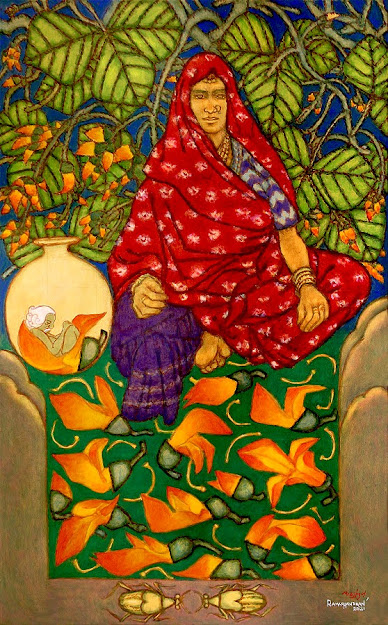
Natyashastra heroines find a Bhil look in A Ramachandran’s newest artwork

New Delhi, Dec. 03 : An amused smile brightens up A. Ramachandran when the octogenarian artist recalls how his fond muses would present themselves for a painting. “The women would have the tip of their long clothe dangle from the forehead.Sometimes down till the neck,” he says. “They least intend to veil their face. I don’t mind that either.”  
The latest paintings of
A Ramachandran


Half a century has passed since the artist has been directly familiar with the Bhil ways of life. The tribal community of Rajasthan has featured fairly regularly in Ramachandran’s artworks from the mid-1980s. The latest in the series, though, stands out for their thematic difference—this time owing to an uncanny link the rustic females bear with the haloed eight heroines from an ancient Sanskrit treatise.


Called ‘Subaltern Ashtanayikas’, the set of paintings is currently on display in the national capital. Paired with his latest images in the famed ‘Lotus Pond’ series, the images totalling 13 made it to two venues of the city by Vadehra Art Gallery (VAG).


The Ashtanayikas, as cited by Bharata Muni in his two-millennium-old work on dramaturgy, portray eight mental states of women in love. The circumstances range from coquettish to distressed to deceived, but overall the concept holds an exalted status in classical paintings, sculpture, dance and literature. “My Nayikas, here, are a far cry from the conventional sensibility. You can even say mine are a pun on the original,” shrugs Padma Bhushan Ramachandran, who lives east of the Yamuna in Delhi.“After all, love is not a privilege of just the pretty. Any kind of man and woman can get attracted to each other.”


The latest paintings of
A Ramachandran

Ramachandran’s Ashtanayikas are today part of Subaltern Nayikas and Lotus Pondbeing held at VAG’s Modern Gallery in Defence Colony. The month-longshow is to end on December 12, while arelated 17-day exhibition at Shridharani Gallery of Triveni Kala Sangam on Tansen Marg (Mandi House) concluded on November 30.


All the eight heroines were painted during the lockdown months that ensued the outbreak of Covid-19. The worldwide pandemic showed its fierce face in Delhi as well, prompting Ramachandran to remain indoors since February last year. That is when the artist decided to experiment with his Bhil tribal women he had sketched during earlier visits to villages around Udaipur in the southern belt of the desert state.


“The attic of my studio has hundreds of such drawings I had done with the Bhil women as the subject. Of late, under virtual house arrest owing to the massive spread of coronavirus, I decided to work on a select few of them,” reveals the Kerala-born artist who did his higher studies at West Bengal’s famed Santiniketan. “Eventually the theme of Ashtanayikas dawned upon me. I chose to work on eight sketches of the Bhil women I had met in the last decade.”


Ramachandran attributes the idea to his “Malayali sense of humour” that tends to be sceptical about idealism. Agrees art historian Rupika Chawla, noting that black humour and irony are intrinsic to Ramachandran’s artistry. “It is typical of his creative programming,” she says. “The artist typically goes for playful use of visual expression.”


The 86-year-old artist says the Bhil women are an especially apt choice to be the Ashtanayikas for his painting, considering theirs is one of India’s oldest communities. “They come as an ancient appearance…also a dying culture.”


Ramachandran, who is a native of Attingal near Thiruvananthapuram, did his Masters in Malayalam literature before leaving for West Bengal in 1957 to enroll as a student at Rabindranath Tagore’s famed institution. He has been a Delhiite since the mid-1960s, having taught at JamiaMilliaIslamia. He is also a winner of prestigious honours such as the KalidasSamman and the Raja Ravi Varma Puraskaram.

मंगलवार, 23 नवंबर 2021

Artist Ramachandran’s work reimagines Bharata Muni’s Ashtanayika concept: Dr R Bindu

New Delhi, Nov 20: Dr R Bindu, Kerala Minister of Higher Education and Social Justice, has said that artist A Ramachandran’s works currently on display at two galleries in the national capital has successfully reimagined the concept of ‘Ashtanayika’ by Bharata Muni by featuring tribal women as its protagonists.
Dr R Bindu, Kerala Minister for higher education and social justice


Speaking after visiting the solo show by artist at Shridharani Gallery of Triveni Kala Sangam here on Saturday, Dr Bindu, who is also in charge of fine arts colleges in the state, said these art works have a politics of their own and can be termed an act of sabotage as it recontextualizes the setting to reflect lives of tribal women. 

 Ashta-Nayika is a collective name for eight types of heroines as classified by sage Bharata in his Sanskrit treatise on performing arts. The paintings also remind one of works by Claude Monet, she said. 

 Thirteen new paintings on display in two galleries in the capital gives an insight into how a prolonged Covid-19 lockdown induced phenomenal experimentations in the content and style of the artist. 

 The exhibition titled ‘Subaltern Nayikas & Lotus Pond’ organized by Vadehra Art Gallery is currently on at two venues -- Triveni Kala Sangam and VAG'S Modern Gallery, Defence Colony, in the national capital. While the show at Shridharani Gallery of Triveni Kala Sangam will end on November 30, the one at VAG Gallery will be on till December 12.

शुक्रवार, 12 नवंबर 2021

Vadehra Art Gallery to show A Ramachandran’s pandemic-time paintings

‘Subaltern Nayikas & Lotus Pond’ to begin in two venues of Delhi from Nov. 14

New Delhi, Nov 12: Thirteen new paintings by renowned A. Ramachandran will be on display in the capital from Sunday, giving an insight into how a prolonged Covid-19 lockdown induced phenomenal experimentations in the content and style of the artist.

A Ramachandran

Being organised by Vadehra Art Gallery (VAG) in two venues of the city, the solo shows will mirror the octogenarian’s latest spell of creativity underlined by visual grandeur and subtle expressions that also helped him counter the melancholy around the worldwide pandemic for almost two years.

Titled Subaltern Nayikas & Lotus Pond, one exhibition will begin this Sunday (November 14) in central Delhi’s Triveni Kala Sangam, while the other will start the next day at VAG’s Modern Gallery in Defence Colony. The show at Shridharani Gallery of Triveni Kala Sangam on Tansen Marg (Mandi House) will span 17 days (November 14-30). The one at VAG Gallery will start on November 15 and last till December 12.

“Both exhibitions will serve as a sample of the master painter’s extraordinary style,” says VAG director Arun Vadehra, who founded the gallery in 1987.


Subaltern Nayika and the Orange Palash Tree, Oil on Canvas, 78" x 48", 2021
Subaltern Nayika and the Orange Palash Tree,
Oil on Canvas, 78" x 48", 2021


Of the 13 paintings, eight will be on the Ashta Nayikas. However, this series by Ramachandran tends to break the exalted status the heroines (nayikas) enjoy in the ancient Natya Shastra written by Bharata Muni. “It’s not just beautiful people who fall in love,” notes the 86-year-old Ramachandran, about the paintings that show faces of Bhil tribal women of northwest India. “Hence the word ‘subaltern’.”

Points out art historian Rupika Chawla: “Black humour and irony are intrinsic to Ramachandran and to his creative programming,” adding that the artist typically goes for “playful use of visual expression.”

As for the ‘Lotus Ponds’, the sprawling water-bodies of Rajasthan have for long been another obsession of Kerala-born Ramachandran. “The artist’s ‘Lotus Ponds’ are not preachy,” says Prof Siva Kumar of Santiniketan from where Ramachandran undertook advanced art studies in the early 1960s. “They invite us to engage deeply, to see, and to acknowledge.”

Ramachandran, who is a native of Attingal near Thiruvananthapuram, did his Masters in Malayalam literature before leaving for West Bengal in 1957 to enroll as a student at Rabindranath Tagore’s famed institution. He has been a Delhiite since the mid-1960s, having taught at Jamia Millia Islamia. A Padma Bhushan awardee, he is also a winner of prestigious honours such as the Kalidas Samman and the Raja Ravi Varma Puraskaram.


Lotus Pond with Water Hyacinth, Oil on Canvas, 78" x 192", 2020

गुरुवार, 30 जुलाई 2020

कोरोना काल में रेखांकन

प्रदर्शनी में कुल सत्रह कलाकार शामिल हैं तीन कलाकार बिहार के हैं शेष दिल्ली में ही रहकर अपनी कला साधना में लगे हैं। इस प्रदर्शनी की एक खास विशेषता है की यथार्थवादी, अतियथार्थवादी, एब्स्ट्रैक्ट, सेमी एब्स्ट्रैक्ट लोककला से प्रभावित सभी तरह के रेखांकन शामिल किये गए हैं।

किशोर रॉय और विश्वजीत पांडा के रेखांकन पूरी तरह अमूर्त हैं वही वेदप्रकाश भारद्धाज, दिलीप शर्मा, अनिल कुमार सिन्हा, अशोक कुमार, मीनाक्षी झा बनर्जी के तीन रेखांकन, मोहम्मद सुलेमान के रेखांकन में अमूर्तन की ओर झुकाव है। राखी, राजेश चंद, संजू दास, उमेश शर्मा और मीनाक्षी झा के रेखांकनों में लोककला की झलक स्पष्ट दिखाई देती है। अजय नारायण, अनिल बल, प्रवीन उपाध्याय और रागिनी सिन्हा के काम में यथार्थवादी और अतियथार्थवादी रुझान देखा जा सकता है। रागिनी सिन्हा, मोहम्मद सुलेमान, किशोर रॉय, दिलीप शर्मा, अशोक कुमार, आशीष मोहन, उमेश शर्मा और विश्वजीत पंडा ने अपने रेखांकनों में हलके रंगों का भी प्रयोग किया है। वेदप्रकाश भारद्वाज, राजेश चन्द, अनिल सिन्हा और अशोक कुमार ने अपने रेखांकनों में गतिमान और बोल्ड रेखाओं का प्रयोग किया है शेष कलाकारों ने महीन और लयात्मक रेखाओं तथा हलके वर्णों के टेक्स्चर का प्रयोग किया है। सभी का काम एक से बढ़कर एक है। ये प्रदर्शनी २५ अगस्त तक एक महीने चलेगी इसके लिंक https://hi.colornspace.in/1x1-drawing-show पर जाकर आप हर कलाकृति को बारीकी से देख सकते हैं l हरेक कलाकृति का मूल्य भी कम से कम रखा गया है ताकि कलाप्रेमी इस अवसर का विशेष लाभ ले सकें।

--रवींद्र कुमार दास
वरिष्ठ कला लेखक
मो. सं.- 9811712309

गुरुवार, 14 मई 2020

United We Fight”

          The Indian Council for Cultural Relations (ICCR) brings together composers, musicians and  singers from across India, contributing recordings from their homes, in a beautiful musical creation “United we Fight”.  Written and composed by Joe Alvares, vocals by Usha Uthup, Salim Merchant, Shefali Alvares Rashid, Benny Dayal, Sonam Kalra, Chandan Bala Kalyan, Joe Alvares, Salome and Samira, and music by Tubby, Pandit Ravi Chari, Pandit Rakesh Chaurasiya and Ustad Faisal Qureshi, this song is a rendition weaving English lyrics into the notes and beats of Indian classical music, spreading the essence of Vasudhaiva Kutumbakam – the world is one family. It carries with it the message of hope, joy, resilience, fighting spirit and never say die attitude of all in our collective fight against COVID 19. 


This virus has had a huge impact on humanity cutting across all boundaries, physical and social, of nations, caste, class, colour, religion and belief systems bringing the world to its knees. But united we stand, steadfastly helping, assisting, sharing knowledge, cooperating and coordinating with each other, cutting across boundaries fighting as ONE force against the Corona virus. 

This composition is an expression of our deep appreciation and gratitude to all brave COVID warriors world over risking their lives to protect ours. It is a homage to all the artists and performers who represent the cultural legacy of our countries and who contribute to keep our cultural heritage vibrant and alive, especially in these difficult times. It is a tribute to and recognition of the countless individuals who are silently helping neighbours, strangers and people around them in these times of distress. A message to the world that TOGETHER we shall surely win the fight against the Corona virus and many such challenges that humanity and the human race faces.  Light a candle, cheer the frontline workers, donate for the needy, spare time for the elderly, be available to volunteer; whichever way, we hope you enjoy this rendition and be inspired enough to continue this “united fight”.

This song is dedicated to the world by the Ministry of External Affairs (MEA) of India. ICCR is MEA’s autonomous organization mandated to build international understanding, develop closer cultural relations between India and other countries and project India’s soft power abroad.

रविवार, 3 मई 2020

Biennale Foundation appoints UAE-based entrepreneur Adeeb Ahamed as trustee

Kochi, May 3: The Kochi Biennale Foundation (KBF) has appointed UAE-based Malayali businessman Adeeb Ahamed as a trustee in its board, seven months ahead of the fifth edition of India’s biggest contemporary art festival.

Mr Ahamed, a native of Thrissur, runs the LuLu Financial Group in Abu Dhabi and is also managing director of its retail arm Tablez and hospitality investment arm Twenty14 Holdings.
 
Adeeb Ahamed, KBF New Trustee
KBF founder president Bose Krishnamachari, while announcing the appointment, spoke of Mr Ahamed’s “active interest in art and culture”, adding he “brings to the table a plethora of ideas and experience as a global businessman”.

It is important that young business leaders be part of the cultural landscape. We’re glad that we could bring on board someone like Mr Ahamed, who shares our vision as an institution,” added Mr Krishnamachari, a renowned artist who was the co-curator of the first Kochi-Muziris Biennale (KMB) in 2012.

The new trustee described KMB as “a great cultural ambassador for Kerala” down the years. “It has extended beyond just art and has given rise to multiple opportunities in the service sector,” he noted.

Mr Ahamed is an influential thought leader and philanthropist with an educational background from Switzerland and the UK. He serves on the senior advisory board of the World Economic Forum’s South Asia Regional Strategy Group that is the highest decision-making body for the global body’s activities in the subcontinent.

Also, Mr Ahamed actively contributes to education and elderly welfare projects. With business operations spanning across 14 countries, he is consistently ranked among the ‘Top 100 Indian Leaders in the Arab World’ by Forbes Middle East.

Art as a healer

With Covid-19 dampening the global economy and people’s morale, the KMB’s theme for the upcoming edition can lead to sustainable dialogue on the role of art in times of human crisis, according to Mr Krishnamachari.

“The ideas of the resilience of the human imagination and of the capacities of art in times of crisis are part of curator Shubigi Rao's conceptual frame for the 2020 Biennale (beginning December 12). This year’s KMB can become a responsive instance of that spirit,” he added.

“The coronavirus situation forces us as a society to re-imagine the coordinates of our relationship to the natural and social worlds, and I'm sure that the space of art is the location at which some of that thinking can take place. The Biennale will also be a signal of confidence — on the part of the artists' community, on the part of the state of Kerala and on the part of progressive culture in India,” he added.

Echoing the thought, Mr Ahamed said Kerala merited “something as extraordinary as the Biennale” to overcome the Covid-19 blues and bring the focus back on the travel economy.

“In the past as well, we have seen people rally around the event to prop up the state’s economy after a crisis. This year, the spirit of oneness is already high everywhere,” he said. “I am confident the KMB will inspire people to appreciate art and its transformative role in the generation of local livelihoods.”

The previous edition of KMB spanned 108 days, featuring 94 artist projects in ten venues of Kochi city and earning 6.2 lakh footfalls.

रविवार, 9 फ़रवरी 2020

India Art Fair 2020 closes successful 12th edition

4 February 2020
India Art Fair closed its 12th edition amidst reports of strong sales, new participation with galleries and cultural institutions as well as a diverse audience of collectors and visitors reflecting a continued growing confidence in modern and contemporary art and the South Asian art market. Presented by BMW Group India, the fair was held from January 30 – February 2, 2020 at the NSIC Exhibition Grounds in New Delhi.

India Art Fair, the leading platform for contemporary and modern art from South Asia, closed its 12th edition on 2 February 2020, amidst strong sales and continued growing confidence in the South Asian art market. The fair was attended by leading gallerist, collectors, artists, museum professionals, philanthropists and students, with exhibitors reporting sales to new collectors entering both the contemporary and modern markets.


India Art Fair featured 81 modern, contemporary and institutional exhibitors, an inaugural performance art programme, outdoor projects, artist talks, workshops, book signings and the launch of the second issue of the annual India Art Fair magazine. The fair’s commitment to the art ecosystem in South Asia was made prominent through a curated programme throughout the fair duration which highlights audience awareness and exploration for Indian, regional and international audiences. The fair façade which featured a work by popular contemporary artist Sameer Kulavoor which covered four exhibition tents.

Jagdip Jagpal, Fair Director, India Art Fair, said: “India Art Fair has grown extensively over the last 12 years. Over this most recent edition, the fair has showcased five hundred artists, each addressing a range of social, political and ecological topics in their individual ways and opening dialogues and perspectives of those visiting from across India and the wider globe. We’ve also engaged with a great range of new visitors and collectors from across the region, and internationally, while also reconnecting our relationships with those who’ve visited previously. With the collector’s masterclass sessions, we’ve also welcomed a great deal of new and young collectors and those with an interest in both modern and contemporary works.

Over the last three years, we have looked to strengthen the programme through expanded talks, performances, a new bookshop and artist led workshops to further engage audiences with art from the region, as well as make the visit to the fair ever more accessible for all ages and abilities, and highlight the very best of the South Asian and Indian art scene. Collaboration and support from across the arts, as well as the strong team behind the fair have all played a hugely important role to helping with this year’s success. We look forward the next edition of India Art Fair in 2021 and the continual support and encouragement from the artists, galleries and exhibitors who have contributed so positively to the great success this year.

Marking their 5th year with India Art Fair, Presenting Partner BMW Group India returned to the fair and showcased the BMW Art Car by Andy Warhol – one of the nineteen prominent artists from across the world to have created Art Cars using contemporary BMW automobiles of their times, which was for this edition, complimented by The Warhol Talk

Rudratej Singh, President and CEO, BMW Group India, said: “At BMW, we just don’t build the best performing cars, but deeply believe in the intangibles. People love BMW for its superior performance, luxurious experience, safety and its underpinning design and aesthetic sensibility. Therefore, to help build and strengthen intercultural platforms of creativity in the field of art, music, design and architecture is very important to us. India Art Fair is a perfect platform for us to reach out to our discerning customers and showcase the brand’s philosophy.”

Building on the success of the last editions, the 2020 fair attendees included prominent collectors and arts industry professionals from across India, the South Asia region and internationally who attended to explore and experience the diverse line up of leading exhibitors alongside a curated programme of performances and talks.

Senior figures in India’s cultural scene attended the fair, including architect Mahendra Raj and David Adjaye, film actress Sonam Kapoor, fashion designers Aneeth Arora, Sanjay Garg, Masaba Gupta, Rashmi Varma, Gaurav Jai Gupta, Nimish Shah, J.J. Valaya and Ranna Gill, writer and author Vikram Seth, philanthropists Kiran Nadar, Roshni Nadar Malhotra, Pinky Reddy, Feroze Gujral and Lekha Poddar. Representatives of large corporations including BNP Paribas, Reliance Group, DLF Limited, Taj Hotels, JSW Foundation, Credit Suisse, Google, RPG Group and NITI Aayog were also present, along with ambassadors and senior government officials from France, Germany, Korea, Brazil, Italy, Canada, United States of American and the United Kingdom.

With the fairs focus on the artists’ voice throughout its programming, the following artists attended: Martin Parr, Marcel Dzama, Nadira Husain, Amar Kanwar, Nilima Sheikh, Gulammohamed Sheikh, Vivan Sundaram, Manu Parekh, Madhvi Parekh, Arpita Singh, Atul Dodiya, Anju Dodiya, Jitish Kallat, Reena Kallat, Shilpa Gupta, Asim Waqif, Mithu Sen, Tayebi Begum Lipi, Tanya Goel, Youdhisthir Maharjan, Ronny Sen and Thukral & Tagra, amongst others.

India Art Fair welcomed a number of visitors which included members and patrons from prestigious institutions featuring the Museum of Modern Art (USA); the Musée des Arts Modernes de la Ville de Paris (France); MFA Houston (USA), The Santa Barbara Museum (USA); Dhondt Dhaenens Museum (Belgium); and the Guggenheim (USA); and collector groups from Russia, Germany and the USA; and visits from Glen Lowry, Director, Museum of Modern Art; Devika Singh, Curator of International Art, Tate Modern; Dr. Mallica Kumbera Landrus, Senior Curator of Indian Collections, Ashmolean Museum; and curators from notable institutions such as Amy Poster (Brooklyn Museum), Aimee Froom (Islamic Worlds at the Museum of Fine Arts) Uthra Rajgopal (Whitworth Museum), Sandhini Poddar and Alexandra Munro (Solomon R Guggenheim Museum), Ritika Biswas (New Art Exchange), Tarun Nagesh (Queensland Art Gallery of Modern Art), Ulrike Groos (Kunstmuseum Stuttgart), Zelfira Tregyulova (Tretyakov State Gallery) and Sophie Makariou (Musée Guimet), and José Carlos Diaz (Andy Warhol Museum), amongst others.


In 2020, India Art Fair has been an all-inclusive event, with a program featuring dedicated tours for supporting special assistance. Art making workshops attracted school students and families providing activities and events for all ages, backgrounds and abilities over the course of the fair. The refreshed layout, and diversity of focused and curated displays was noted by many visitors, along with the high standard of gallery presentations showcasing a breadth of work from around the world.

After nine years of being at NSIC, the 13th edition of India Art Fair will take place at Pragati Maidan in New Delhi within the newly built exhibition halls, from 18 February to 21 February 2021.

शनिवार, 8 फ़रवरी 2020

Alliance Française de Delhi presents Khushboo

Alliance Française de Delhi presents Khushboo on 14th February 2020: An Evening of Indo-French Music and Dance! A medley of talented musicians and dancers from France and India come together for a unique performance that highlights the best of both cultures and uncovers synergies between them while celebrating unique aspects of each! Seven masterful performers with eclectic talents and skills including will come together to create multidisciplinary dance and musical magic! The artists include:

Mahua Shankar (kathak dance)
GulaboSapera (sapera dance)
Murad Ali Khan (sarangi)
Titi Robin (compositions,bouzoug, guitar)
Shuheb Hasan
Dino Banjara (percussion)
Amaan Ali Khan (tabla).


Sarangi Maestro Murad Ali Khan and French composer Titi Robin have been working together on joint artistic projects for the last ten years, from the first recording of Laal Asmaan in Bombay (Blue Frog Label) to the international show Les Rives until the last album Rebel Diwana produced in Belgium. Padma Shri Gulabo Sapera and Titi Robin began their collaboration in the early 90s with the Gitans album, the first of a long series of recording, videos and numerous tours around the globe. Murad Ali Khan had the rich idea to reunite on stage the eminent representative of the Rajasthan dance sapera with one of the brilliant stars of kathak classical dance, Mahua Shankar.

From this original and innovative meeting, motivated by the pleasure of exchange and sharing, was born this color of the emotion and this "khushboo" (perfume) of the soul that the artistic languages ​​have for mission to create and transmit.

This evening will bring to life the tribal-gypsy dance style from Rajasthan along with classical instruments and sounds from Europe - a wonderful blend of cultures. The originality and innovative flair of each performer perfumed with the emotive soulfulness of each discipline results in a unique blend that transcends cultural boundaries and language barriers.

शुक्रवार, 24 जनवरी 2020

Alliance Française de Delhi presents a unique contemporary dance performance

Dance or Chaos by Souleymane Sanogo
31.01.2020 at 6:30pm

For the first time ever, Alliance Française de Delhi brings to you an extraordinary contemporary solo dance performance titled Dance or Chaos picturing a choreographic documentary by and about the Malian dancer, Souleymane Sanogo. Through this documentary-choreography, Souleymane offers us the powerful story of his life.This choregraphic work introduces us to his life marked by brutality and misery, growing up on the streets of Bamako, Mali. This work caught the attention of P.A.R.T.S., the choreography school founded in Brussels by Anne Teresa de Keersmaeker, which is also one of the most selective dance companies in the world.

It is by the expressive force of his art that one enters into the flesh of history, that one sees the deep springs, that one discovers the meanders of his life, a life of misery and brutality. Souleymane Sanogo flails his arms as his dreadlocks fly — he’s in a trance, behind him are odd props. The movements, sometimes abstract, sometimes to a certain rhythm akin to traditional African beats, invite one to connect them to his story. In between, he narrates too, trying to paint a picture of his life’s struggles in French and broken English.

The story of Souleymane Sanogo
Born on October 24, 1988 in Somadougou, central Mali. His childhood is devoted to the tasks of the house and the work of the fields. At the age of fifteen, he fled to Bamako, where he shares the lives of street children. He discovered dance in 2003 thanks to the Haitian choreographer Kettly Noël, who organizes workshops for street children in his Bamako choreographic centerDonkoSéko. He meets choreographers from around the world. At the same time, he learns to read and write. From 2005, he is regularly engaged as an interpreter in choreographies, many of which are internationally distributed. This is particularly the case in 2006 with "Waterproof", a creation of AnusckaBrodacz (The Young Company) through which he discovers Italy, "Chez Rosette" (Kettly Noël, 2008) who knows a beautiful French tour or & quot; Confinement" (Nelisiwe Xaba 1010), a piece that takes him to South Africa. In 2010, he participated in the creation of Copier- Coller, a Bamako contemporary dance company based in the popular district of Sabaligougou. During this period, he participated in one way or another in most of the major choreographic events held in West Africa. In 2011-2012, the Malian theatrical company BlonBa asked him for the creation of his show "Alatèsunogo" (God does not sleep) that mixes theater and contemporary dance and with which it turns in Mali, France and Central Africa. He is then selected by PARTS, the internationally renowned Brussels school founded by choreographer Anne Teresa de Keersmaeker, whose cycle he ends in 2016.

Andy Warhol’s 1979 BMW Art Car to be showcased at India Art Fair 2020

India Art Fair, the leading platform for modern and contemporary art from South Asia, will return to New Delhi with an exclusive showcase of Andy Warhol’s BMW Art Car by Presenting Partner BMW Group India. Combining Warhol’s characteristic pop-art style with movement and speed, the Art Car painted by the iconic American artist is predicted to be a popular addition to the fair programme.
 
Andy Warhol's BMW Art Car, 1979. Courtesy of BMW Group India


The 2020 fair marks the fifth anniversary of a creative partnership with BMW Group India who continue to remain a strong pillar for the arts in India. To celebrate the occasion, the fair will also host The Warhol Talk with Thomas Girst, Head of BMW Cultural Engagement and Jose Carlos Diaz, Chief Curator at The Andy Warhol Museum – a conversation about Andy Warhol’s fascinating life and career, including the making of his BMW Art Car in 1979.

In previous editions, BMW Group India have presented outstanding Art Cars created by prominent artists from across the world including Cesar Manrique, Sandro Chia, Jeff Koons and David Hockney, all of which are permanently housed in the BMW Museum in Munich.

Commenting on the association with BMW Group India, Jagdip Jagpal, Fair Director, India Art Fair said, “We are incredibly pleased to be working with BMW Group India for the 5th year running. Their continued support, commitment and patronage has enabled us to achieve our goal in positioning India Art Fair as South Asia’s leading platform to discover modern and contemporary art.

DAG presents The Fifties Show: Works of Indian Modernism at The Claridges

The Fifties Show revisits a momentous decade of newly-independent India that had just put its colonised past behind it to embrace a triumphant modernism.

NEW DELHI, 1 st February, 2020 - DAG’s new space at The Claridges, New Delhi, will see the opening of its latest exhibition, titled The Fifties Show. This exhibition encapsulates key highlights in Indian art over a decade of the 1950s, spotlighting how a newly-independent nation put its colonised past behind and embraced triumphant modernism.
कैप्शन जोड़ें

Indian art in the twentieth century witnessed two important decades: The first one was the 1910s when the Bengal School saw the establishment of the "revivalist practice" that came
to signify Indian modern art in general. Another was the 1950s, when Indian artists of independent India embraced modernish that was free of their colonial history.

In 1950, the first copy of the Constitution of India, handcrafted and illustrated by Nandalal Bose and other Santiniketan artists, was dedicated to the republic, the Progressives were at the peak of their oeuvre, and younger artists were challenging their place with bold formats of art-making.

The 1950s was a period of hope and celebration, which saw the creation of works emblematic not just of the decade but of the context and subtexts of modernism itself. A period when the best and brightest in the Indian art world—such as Nandlal Bose, M F Husain, S H Raza, F N Souza, G R Santosh, K K Hebbar, Adi Davierwalla, Shanti Dave, Dhanraj Bhagat, etc—created some of their most significant masterpieces.

The exhibition will be on view from 1 February 2020 – 26 th March 2020


गुरुवार, 16 जनवरी 2020

ख्यातिप्राप्त कलाकारों की कृतियों के साथ "सी एस ओ आई आर्ट सम्मिट" का शुभारम्भ

आज के वैज्ञानिक युग में आधुनिक उपकरणों ने कला एवं कलाकार को व्यापक दर्शक दिए हैं पर मूल कलाकृति को अपनी आँखों से देखने एवं मासूस करने की लालसा ही है जो कलाकारों एवं कला प्रेमियों को दीर्घाओं तक खींच लाती है।
 
 
प्रदर्शनी के कलाकार 
दिल्ली की सर्द हवाओं के बीच रंगों एवं आकृतिओं से सजी ख्याति प्राप्त कलाकारों की सामूहिक कला प्रदर्शनी का उद्घाटन राष्ट्रीय आधुनिक कला संग्रहालय, दिल्ली  के महानिदेशक श्री अद्वैत गणनायक ने आज शाम दीप जला कर किया। दिल्ली के चाणक्यपुरी स्थित CSOI आर्ट गैलरी में "कलर एन स्पेस आर्टिस्ट स्टूडियो,  नई दिल्ली" एवं  "CIVIL SERVICES OFFICERS INSTITUTE ( CSOI ) " के  संयुक्त तत्वावधान में  सामूहिक कला प्रदर्शनी के उद्घाटन अवसर पर श्री गणनायक ने आयोजन की प्रशंसा के साथ - साथ कलाकारों के हुनर की भी खूब तारीफ की।  


प्रदर्शनी एवं स्लइड शो में भाग लेने वाले कलाकारों में - अजय नारायण , सचिन्द्र नाथ झा , अरविन्द सिंह , राजेश चन्द , शिखा सिन्हा , कुमार रंजन, शिखा माथुर , उदय पंडित, नरेंद्र पाल सिंह , रागिनी सिन्हा , अर्चना सिंह , रबिन्द्र कुमार दास , सूरज कुमार काशी , बिपिन कुमार , आशीष मोहन , भुनेश्वर भास्कर , पंकज सिंह , उमेश प्रसाद , उमा शंकर पाठक ,  ज्योति सिंह , कल्पना , मनीषा सिंह शामिल हैं।


इस प्रदर्शनी में देश कुल 23  ख्यातिप्राप्त कलाकारों की कलाकृतियाँ प्रदर्शित की गई हैं, जिनमे 17 कलाकारों की चित्रकृति एवं 6  कलाकारों की मूर्तिशिल्प प्रदर्शित हैं। 15 दिनों तक चलने वाले इस आयोजन का नाम " आर्ट सम्मिट " दिया गया है। इसके अंतर्गत कलाकारों के मूल निवास के आधार पर अलग-अलग राज्यों की प्रदर्शनियां आयोजित की जाएगी। यह प्रदर्शनी इस आयोजन की पहली कड़ी है जिसमें बिहार के वरिष्ठ कलाकारों को शामिल किया गया है।  सम्मिट में समय समय पर कलाकारों के कालयात्रा से सम्बद्ध स्लइड शो एवं उनपर चर्चा का भी आयोजन किया जाएगा।