शुक्रवार, 26 सितंबर 2014

Six-dance show unveils pan-Indian aesthetics at SAARC Culture Ministers Meet

New Delhi, Sep 25: In a little over half-an-hour, the visual treat encapsulated the rich variety of India’s performance arts in its entirety.
Dances, drama and melodies from the north, east, west and south of the host nation dazzled delegates at the Third Meeting of SAARC Ministers of Culture, as the 40-minute show highlighted the individuality and commonalities of classical, folk and martial traditions of the country.
Six traditional Indian dances come together at
Nrityarupa programme staged as part of the 3rd SAARC Cultural Ministers' Meeting,
 at The Ashok, yesterday evening (1)

Presented under the aegis of Sangeet Natak Akademi which also crafted the programme, ‘Nrityarupa’ brought out the essential charm and collaborative beauty of Bharatanatyam, Kathakali (both from the south), Kathak (north and west), Odissi and Chhau (east) and Manipuri (Northeast) before an august audience featuring ministers and diplomats among other dignitaries.
Addressing the gathering at The Ashoka hotel on Wednesday evening, India’s Minister of State for Culture Shripad Yesso Naik noted that the two-day conclave was striving to lay a time-bound roadmap that would work substantively to revitalize cultural institutions and re-inject enthusiasm among artists, writers and scholars who work in the areas of the dance, literature, museum, archives, libraries, oral narratives and modern art.
कैप्शन जोड़ें
“Towards this end, India is willing to commit its time, manpower and resources for strengthening institutions in the region so that we can preserve our rich cultural heritages and particularly preserve the hundreds of thousands of mini-narratives which are in danger of being lost forever to future generations,” he noted at the banquet speech, hours after officials of eight-nation conglomeration held talks on taking forward cultural cooperation.
‘Nrityarupa’, choreographed by frontline Kathak exponent Rajendra Gangani, wove a tapestry of celebrated Indian dances, thus demonstrating a kinetic synergy between them. As their seamless portrayal eventually led to a jubilant flourish, the spectators gave the artistes a cheerful ovation.
Light-designed by Sreekanth Nair, the package unrolled gracefully with a piece invoking Lord Shiva. The hymnal offering symbolised the cosmic cycle of creation and destruction, as the Shiva Stuti drew in artistes in pairs representing the six dances.
Subsequently, they also found individual demonstration before finally the dancers performedtogether to a uniform rhythm. That climactic tarana melody merged the streams into a pure-dance passage, symbolising the essential Indian spirit of union despite its cultural differences regionally.

The artistes were Arun Sankar, Rajamally B (Bharatanatyam), Gauri Diwakar (Kathak), Nikhil Lal (Chhau), Shagun Butani, Asha Kumari (Odissi), Chandan Devi, Meneka Devi (Manipuri) and M Amaljith (Kathakali).

बुधवार, 24 सितंबर 2014

Bharatanatyam recital enthrals SAARC delegates ahead of meet

New Delhi, Sep 24: The Third Meeting of SAARC Ministers of Culture which began here today got a slice of India’s rich culture on the eve of the two-day international meet when leaders and delegates were treated to a Bharatanatyam recital from the south of the country.


Five young artistes from Chennai’s Kalakshetra showcased the vivacity and variety of the classical dance before an audience that comprised ministers, top bureaucrats and their families from the eight member-nations of the 1985-founded South Asian Association for Regional Cooperation, or SAARC.


The 50-minute show, which was organised by Sangeet Natak Akademi on Tuesday evening, was strung together by frontline dancer Priyadarshini Govind who is currently the director of the 1936-established institution.

Artistes from Chennai-based Kalakshetra Repertory Company
 perform Bharatanatyam in New Delhi on Sep 23 
Tuesday on the eve of the
 Third SAARC Culture Ministers Conference in the national capital.

As the dancers — three of them males — presented four celebrated items to recorded music at The Ashok hotel in the capital, the SAARC delegates from Sri Lanka, Nepal, Bangladesh, Pakistan, Afghanistan, Bhutan and the Maldives besides host India watched in relaxed attention. The end of the performance saw them applaud the artistes with long rounds of claps, much to the pleasure of Priyadarshini and the Kalakshetra Repertory Company artistes Hari Padman, Sibi Sudarsan, K P Rakesh, Indu Mohan and K Sharada Acharya.


Culture Secretary Ravindra Singh said before the start of the show that India was seeking to strengthen cultural ties with the rest of the SAARC nations. “We share centuries of history,” he noted, adding that the deep bond manifests in matters ranging from food, art and literature.

Culture Secretary Ravindra Singh and Joint Secretary V Srinivas on stage, flanking Kalakshetra director Priyadarshini Govind, after a Bharatanatyam show by the Chennai-based institution's repertory company's five dancers on Sep 23 Tuesday on the eve of the Third SAARC Culture Ministers Conference in the national capital.


The dance recital, according to Priyadarshini, eminently mirrored the insight and spirit of Bharatanatyam gurus, including legendary theosophist Rukmini Devi Arundale who founded Kalakshetra in 1936.


Mr Singh presented Priyadarshini and the stage artistes with shawls.


The dance programme began with the invocatory Allarippu in raga Nattai, followed by a Jatiswaram in Kalyani and set to the three-beat roopaka taal. Then came the main piece, a Keertana on Nataraja (set to Kedaragoula raga and choreographed by the couple V P Dhananjayan and Shanta). The recital concluded with a Tillana composed by 20th-century musician Papanasam Sivan in raga Hindolam.

सोमवार, 15 सितंबर 2014

9th National Museum Lecture by Dr. Parul Pandya Dhar

Art historian, author and classical dancer, Professor Parul Pandya Dhar, University of Delhi, delivers the 9th National Museum lecture in Delhi on 'Scattered Across Museums: Re-collecting Vietnam's Buddhist Past' on Sep 12.


Professor Parul Pandya Dhar delivers the 9th National Museum Lecture (1)

Professor Parul Pandya Dhar delivers the 9th National Museum Lecture (2)

रविवार, 14 सितंबर 2014

100 Days Away, Biennale 2014 Braces Up For Bigger Success


Kochi is gearing up to host the second edition of Kochi-Muziris Biennale, as the organisers of the 108-day mega art event starting on December 12 are busy with the preparations for the much-acclaimed mega art festival that is slated to conclude on March 29, 2015.

Jitish Kallat, the curator and artistic director for the biennale being organised by the Kochi Biennale Foundation (KBF), said the second edition would feature around 85 artists from over 28 countries.


Some of the key artists have already made site visits, and they include Franceso Clemente, Sir Anish Kapoor, Christian Waldvogel, K G Subramanyan, Sudhir Patwardhan, Ghulammohammed Sheikh and Namboodiri, among others.

Kallat said it was a “rewarding moment” for him when conversations with artist-colleagues, concretize into projects on the ground in Kochi. “The embryonic form of the project is taking shape,” he noted. “The exhibition brings together art-works that picture versions of the world referencing history, geography, astronomy, time and myth, interlacing the terrestrial with the celestial.”

The full list of artists will be announced at an exclusive event in a few weeks.

Kallat had been engaged in a year-long research trip to select the artists for the much-awaited second edition.


The organisers are prepping up the venues for the second edition as artists have already started working on site.

KBF president Bose Krishnamachari said the foundation has retained most of the venues from last time. “But we will have a few additional venues and projects in a few public spaces. And we are looking forward to an engaging project put up by Kallat,” he added.

KBF has been organising several talks and cultural programmes as a run-up to the Biennale. Riyas Komu, Director of Programmes, said the KBF has always been mindful of the larger participation of the people to engage them with contemporary art.


“To amplify it this time, we will be having several Programmes including the Student’s Biennale, Children’s Biennale, Artists’ Cinema project and various Cultural Programmes that will run parallel to the Biennale,” he added.


The first edition held in 2012 was an unprecedented national and international success.  As expectations run high this time, most of the hotels, home-stays and boarding and lodging houses in Fort Kochi and nearby areas have been completely pre-booked.

एन. डी. एम. सी. की अखिल भारतीय कला प्रदर्शनी 2014 में बिहारी कलाकार


सोमवार, 28 अप्रैल 2014

Portrayal of Indian womanhood in various hues

New Delhi, April 28: Seething with anger at the Kauravas who have tried to disrobe her, Draupadi unlocks her long wavy tresses with a vow that she will tie it again only after smearing it with the blood of Dushasan, the main culprit.
The flowing hair, a two-metre-long work of threads and metal hooks and interspersed with glistening red beads symbolising blood of her tormentor, lies in a glass case at an ongoing exhibition at the National Museum.   
Barely some distance away, a curvaceous celestial beauty (10th century sandstone Apsara from Khajuraho) stands under a tree, scribbling a note of love on parchment. There are nail-marks on her back – a sort of inscription of her lover’s passionate lovemaking the night before. 
These are among the stirring images of Indian womanhood that filter into your mindscape as you make a round of “The Body in Indian Art”, a mammoth eight-gallery exhibition that depicts the single theme of the body with multiple expressions of art.


Significantly, these images tend to break the stereotypes of Indian womanhood, which has mostly oscillated between the two extremes of divinity (Sita, Ahalya) and sensuous physicality (Khajuraho, Kamasutra). India does celebrate the varied shade of aesthetics of femininity, but this exhibition is an incredible depiction of womanhood in its scale and depth.
Curated by Dr Naman Ahuja, Associate Professor of Ancient Indian Art and Architecture at Jawaharlal Nehru University, the exhibition (titled ‘Roop-Pratiroop’ in Hindi) goes beyond the clichéd images and patterns to depict the Indian womanhood in all its shades – ugly and serene, shame and honour, valour and servility – expressed through images of making love, seeking revenge, committing Sati, and becoming an ascetic, among others.    
The female figures are not pertinent to the aesthetics of a particular era or faith or region or culture. Overall, they encompass looks ranging from serene to violent, from sensuous to divine, thus portraying concepts and emotions as vast as heroism, asceticism, adoption, fertility, eroticism and rancour, among others.
The 11-week (March 14 to June 7) show has been arranged in conformity with the idea of depicting the thesis along with the antithesis in each of the eight specially-designed galleries. The trail follows no chronological order; instead it goes by themes such as death, birth, rebirth, heroism, asceticism and rapture. 
Some of the exhibits depicting the womanhood are ‘Virasati’ (commemorating a woman warrior from 13th century AD); a textile installation (of the female genital) by new-age artist Mrinalini Mukherjee; an 18th-century wooden sculpture of a squatting woman giving birth to a baby; the Mother Goddesses from Harappa; demoness Putana suckling Krishna; Mallinatha (the Jain woman ascetic); Saptamatrika or The Seven Mothers (a 2nd or 3rd century AD terracotta work from Patna Museum); and Surasundaris (a celebration of the body).
“The body is the bedrock of the studies of art and civilisation in India. The exhibition seeks to portray the images of women as perceived by different communities and religions spanning four millennia of Indian civilization,” Dr. Ahuja says about his magnum opus, which comes to India after enthralling the audiences at Brussels as part of the famed Europalia art show. The event in the Belgian capital attracted an audience of over one million people.


There is a section of the exhibition that looks at the birth of key figures from various religions, among them Krishna, Buddha, Ram and Jesus. All these figures were born as a result of an Immaculate Conception or miraculous event – a phenomenon that makes them divine. Krishna was given up for adoption while Jain leader Mahavira was transferred – as an embryo – from the womb of his biological mother to another womb. Significantly, these age-old mythic stories have compelling resonance in modern times in the concepts of adoption, surrogacy and in-vitro fertilisation.
Dr Ahuja says there is no linear way to express femininity. While the apsara sculpture from Khajuraho celebrates the erotic power of the body, the imperfection is portrayed in the mid-20th century wooden carving of the demoness Putana, who is trying to kill the infant Krishna by smearing her breasts with poison.
There is a statue of a woman warrior from the Kakatiya period (1083-1323 AD) who is severing her head with a sharp weapon. “It is rare to find examples of women warriors being commemorated, and it could find a reflection in modern-day women suicide bombers,” observes the curator. “Women were also commemorated for their valour and fidelity. This was more commonly done for those who committed sati, which is reflected in two 13th century sati memorial stones.” 
Contemporary Indian art has also found a place in the exhibition, which weaves the subjects of birth, death and rapture into the making of a civilisation. Sheela Gowda brings back to the exhibition her 1997 work “Draupadi’s Vow”; photo artist N.Pushpamala lends a picture from her collection ‘Native Women’(2000-2004) to visually analyze women’s submission to cultural codes of India’s colonial rulers.

“This exhibition is a watershed,” says National Museum Director General Dr Venu V. “It is more than double the size of the biggest exhibition we have ever had. Nearly a quarter of the objects have never been shown before.”

सोमवार, 14 अप्रैल 2014

इमोशन आर्ट शो , पटना


Comics artists give new hues to National Museum show on body

New Delhi, April 14: If display of historical artworks is meant to trigger novel interpretations,then a landmark exhibition at National Museum here is lending unconventional ideas to the mission. 
A comics workshop the museum held as part of ‘The Body in Indian Art’ brought in close to 20 artists, who have begun working on freewheeling thoughts that occurred to them after viewing the 300-plus objects which grace the eleven-week show ending in June.
Organised in collaboration with World Comics India, the two-day get-together of young artistes over the weekend saw their sketching imaginary stories coloured on the impression they got on seeing the exhibits that throw light primarily on the depiction of the body over a span of four millennia — across India’s religions, cultures and regions.
National Museum Director-General Dr Venu V said the idea behind the workshop was to widen the reach of the March 14-June 7 show to people from various walks and sense their varied feedback. “The exercise would add to the aesthetic dimensions of the exhibition,” he said, referring to ‘The Body in Indian Art’ curated by art historian Naman P Ahuja.
The delegates at the workshop that concluded on Sunday evening are slated to submit their artwork in a week. “We plan to come up with a booklet showcasing the comics,” added Dr Venu.
World Comics India founder Sharad Sharma, who conducted the workshop, said the exhibition has stimulated the imagination of the artists — they include painters, graphic designers and even a Scandinavian working with her country’s embassy in Delhi.
“Almost all of them have come up with exciting themes, often hilarious,” he revealed, while guiding the youngsters on executing their plots. “Quite a few are sarcastic — brimming with social, political and historical undertones.”
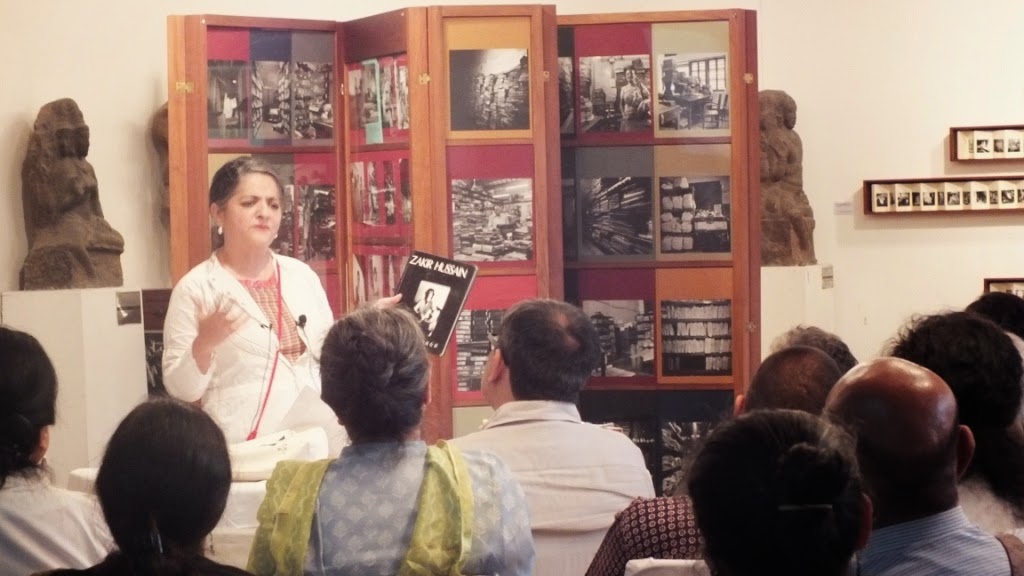
Dayanita Singh giving her talk at the Book Museum, National Museum, New Delhi
All the same, not all themes are in lighter vein. For instance, artist Bhanu Pratap said he was working on the mindset of old-time sculptors who invariably left their work unsigned — “something that is unimaginable today.”
Norwegian Kathrine Flaak said her focus would be on “the changing manmade image of beauty” over the years.
The workshop began on Saturday, hours after National Museum hosted a talk by renowned photographic artist Dayanita Singh, whose show titled ‘Book Museum’ has been on view (from March 10 to May 10) at the second floor.
 Participants at the comics workshop captured by the Facilitator, Sharad Sharma

In her hour-long Friday evening talk on ‘Building the Book Museum: photography, language, form’, the author recalled her experiences in the field of capturing images and writing on them.
She also explained how the book can be “a museum without walls”, capable of taking its own trajectories by making it to the houses of people across the globe.

सोमवार, 24 मार्च 2014

Rare art objects, never shown before, line up for exhibition at National Museum

New   Delhi, Mar 24: With museums across the country opening their vaults for a mammoth exhibition currently underway in the national capital, an array of exquisite art objects, ranging  from the Harappan civilisation to modern times, have become available for public viewing for the first time.

A few tiny Harappan figures, a monumental Naga Deva, an 8th-century Uma-Maheshvara, an animal-headed anthropomorph and a marble tomb of a Mughal lady are among the artefacts being shown for the first time as part of ‘The Body in Indian Art’ at the National Museum.

 
The Nativity of Mary
Curated by art historian Naman P. Ahuja, the eight-gallery exhibition explores the complex understandings of the ‘Body’ in Indian art. This he does through an entire gamut of cultural artefacts such as sculptures, paintings, masks, jewellery, amulets, posters, video installations, music clips and two large textiles.

The 11-week high-voltage exhibition at the museum comes after a successful showing in Brussels as part of the art festival Europalia which concluded recently.

“Around 20-25 per cent of the 300-odd artefacts in the exhibition have never been shown  before and another 60 per cent have seldom been seen before as they were lying in museums in small towns and were too fragile to be sent to Brussels,” pointed out Dr Ahuja, an Associate Professor at Jawaharlal Nehru University, Delhi.

The curator, who has spent years exploring the storerooms (reserve collections) of numerous small regional museums, said he and his curatorial team located many objects that were not on public display. Some were even in the gardens of museums and had thus escaped any critical attention from scholars.

A significant new discovery is the boar-headed copper anthropomorph (2nd or 1st millennium BC) which was lying unnoticed in a museum storeroom. Exhibited in Brussels for the first time, it has now been properly catalogued and is on display here.

“It is a rare piece of art that existed between the Harappan civilisation and the Mauryan Empire, and takes the story of Indian gods and goddesses to an earlier date than what we had imagined… It is a huge find and an exciting object for art historians, archaeologists and linguists.”

Equally fascinating are some tiny Harrapan figures that are on display here for the first time since they were excavated in 1933. They comprise a steatite Seal (2500-1700 BC from Kalibangan, Rajasthan); a terracotta female figurine with animal horns (2500-1700 BC, Mohenjodaro); and two horned maskes (both almost identical). All these objects have been lying in the cells of ASI at Purana Quila, Delhi.

Similarly, a monumental Naga Deva — a 9th century sculpture — has been lent by the Bhopal Museum, and it has never been shown in a public exhibition before. This remarkable statue is carved from a porous stone that flakes in a manner that gives it the appearance of snakeskin.  

 
Animal headed Anthropomorph
National Museum Director-General Dr Venu V said the exhibition is the most extensive collaboration of museums and collectors across the country. “Significantly, it has brought into public domain a number of art objects that have remained largely hidden for the outside world.”

The exhibition in Delhi also features some objects which did not go to Brussels. An 8th century Uma-Maheshvara, which has been on display in the Bhopal Museum but never in a public exhibition before, is one such instance. 

Another object being shown for the first time in India is a marble tomb of a Mughal lady (Delhi region, 17th century). Kept in the ASI’s Red Fort Archaeological Museum, it is a wonderful example of Islamic art. Judging by its lavish, white marble and fine calligraphy, it must have belonged to a member of the imperial family.   

A tiny toe-suckling ‘Bal Krishna’ in bronze was found in the storeroom of Chennai Museum. It did go to Brussels but is being exhibited in India for the first time. 

Particularly special is the book Akitoosha-i-ukba (Provision for the next world). Made of copper pages with silver calligraphy, there are the 99 names of Allah inscribed in this extremely rare book. Being shown for the first time, this is from the ASI’s Museum, Red Fort. It was made during the reign of Aurangzeb.

The National Museum, the biggest lender of objects to the exhibition, has also opened its magnificent reserve collections for first-time viewing. This includes a page of the Shahnama (written by Persian poet Firdausi between 977 and 1010 AD), depicting the birth of Rustom, the legendary Persian warrior.

 
The Birth of Rustam folio from Shahnamah
It has also lent a Mughal painting of the Birth of Mary, based on an engraving by Dutch painter Cornelius Cort (around 1735). Made in the court of Mohammed Shah, it depicts the bathing of new born Mary, mother of Jesus, by a group of female attendants. 


The Odisha State Museum, Bhubaneswar has lent eight sculptures, collectively known as Ashta Dikpala (Gods of Eight Directions). At Brussels, only five of these sculptures, dating from the 12th century, were shown. But in the Delhi exhibition, all the eight are on display. 

गुरुवार, 20 मार्च 2014

पटना में लोक कलाकारों की वृहद कला कार्यशाला 21 से

पटना, 20 मार्च 2014, कला संस्कृति एवं युवा विभाग, बिहार सरकार एवं बिहार ललित कला अकादमी, पटना  संयुक्त रूप से दिनांक  21 मार्च से 25 मार्च तक पटना के बहुद्देशीय सांस्कृतिक परिसर में लोक कलाकारों की वृहद कला कार्यशाला का आयोजन करने जा रही है। पाँच दिनों की इस कार्यशाला में राज्य भर से विभिन्न विधाओं के लोक कलाकार हिस्सा लेंगे। मिथिला कला, मञ्जूषा कला, टिकुली कला, सिक्की कला, टेराकोटा, पेपरमेसी एवं भोजपुरी लोक कला के क्षेत्र से 100 कलाकारों का चयन इस कार्यशाला के लिए किया गया है।

इस कार्यशाला का उद्घाटन 21 मार्च को कला संस्कृति एवं युवा विभाग, बिहार सरकार के सचिव श्री चंचल कुमार  करेंगे। कार्यक्रम की अध्यक्षता बिहार ललित कला अकादमी के अध्यक्ष एवं वरिष्ठ चित्रकार श्री आनंदी प्रसाद बादल करेंगे।     

Museum exhibitions lend contemporary context to artefacts: Expert

New Delhi, March 20: The age-old inclusiveness of Indian culture is second to none globally and a landmark exhibition currently on in the country’s capital mirrors its range and depth, according to renowned art historian Neil MacGregor, who is director of the British Museum.

‘The Body in Indian Art’, which opened in National Museum last week showcasing a broad spectrum of aesthetics in the representation of the human body, exemplifies the harmonious coexistence of religions in the subcontinent over the past four millennia, the London-based expert noted in a lecture here.

“Ideally, museums have to be a secular space. The exhibition reveals its grand extent,” he said in his talk on ‘What can Exhibitions do for Museums’ which was the third in a monthly series that brings together experts and practitioners from the field of world art and culture for Indian audiences.
Dr Neil MacGregor, Director, British Museum,
 speaking at the Third National Museum Lecture at the National Museum, Delhi


Dr MacGregor said it “is indeed remarkable” that the National Museum has pulled together artefacts from over 40 institutions in the eleven-week show here, considering a general reluctance among museums to lend their objects for exhibitions. “This, when there is a surge in public appetite to view and experience cultures from across the world,” added the speaker, who has been heading the British Museum in London for 12 years after having been director of the National Gallery in the same city.

On its part, the British Museum that gets over 6 million visitors a year has been sending its artefacts for exhibitions round the globe in a big way for the past two decades, earning not just admirers from across regions and cultures but also triggering fascinatingly different interpretations to the historical pieces. Redefining old objects is a major benefit of such an exercise, which can also help museums gross additional money through increased footfalls, he added.
Dr Neil MacGregor, Director, British Museum, speaking at the Third National Museum Lecture
 at the National Museum, Delhi (2)

The lecture on Tuesday came amid the March 14-June 7 show curated by Dr Naman P Ahuja of Jawaharlal Nehru University here in association with the Indian Council for Cultural Relations.

“Objects mean different things to different peoples,” Dr MacGregor said, recalling the variedly fascinating response the esoteric Cyrus Cylinder got when British Museum showed the 6th century BC artefact in four American cities in 2010.

While it was seen more as an art object in the US, the Cyrus Cylinder was revered when it was displayed in Tehran on a loan to the museum in Iran. Recently, it was exhibited in Mumbai as well.

Similarly, an armchair throne made of decommissioned (Western) weapons — a representation of the end of a bloody civil war in Mozambique in the late 1970s — underwent a change of profile when it was shown to a different audience. While the object gained its shape following a peace-loving priest’s call to barter guns for gifts, its 2012 display in the British Museum lent the exhibit a completely different perception: it is all European ammunitions that are used in African battles.

International exhibitions can also conjure up contemporary art inspired by ancient works, pointed out the 67-year-old author who has played a vital role in British Museum’s recent leap from being traditional to contemporary and popular. For example, an exhibition of a Roman copy of the famed Greek ‘discus thrower’ sculpture of the 5th century BC prompted a Chinese artist to mould a clothed version of it recently, he pointed out, screening the contrasting image of middle-aged Sui Jianguo’s ‘Drapery Folds’ work at Beijing Museum in 2012.

“When you lend an object, everyone interprets it in his own way, in his own tradition…. We want museums to speak to everybody, especially those who are not concerned about high cultural objects…. Museums are the place where dialogues and discourses can take place which is not possible in any other public place,” he contended.

Expounding on the theme, the art historian said an exhibition in the British Museum on the Haj turned out to be a crowd-puller, attracting a mixed and eclectic gathering and 40 per cent of them were first-time visitors.

“Citizens across the globe feel they share the inheritance, and museums have a central role to play in creating a fusion through democratic discourses and dialogues,” he asserted. 

Dr MacGregor is in India on the occasion of the Third Leadership Training Programme for Museum Professionals which is organised by the Union Ministry of Culture in collaboration with British Museum. The annual project will train 20 young museum professionals in museum management and leadership.


The participants at the training range from museums at the national level (like Bhopal and Hyderabad) to small private museums, say, in Kargil.

सोमवार, 3 मार्च 2014

Museums on Muziris heritage opened to public

KOCHI (North Paravur, Mar 3): People of Kerala will hereafter get a chance to learn the rich bygone era of a “lost city” which played a crucial role in moulding the socio-politico culture of the state, with the government on Sunday opening four museums under the Muziris Heritage Project.

The museums available for visitors are the Kerala History Museum, housed in the Paliam Kovilakam, Kerala Lifestyle Museum in Paliam Nalukettu, Kerala Jews Historical Museum housed in Paravur Synagogue and Kerala Jews Lifestyle Museum in Chendamangalam Synagogue. All museums are equipped with video screens, touch screens and information panels to help the visitors understand the rich history of the region.
 
Paliam Trust manager Krishnabalan Paliath explaining the details of the antiques displayed at Kerala History Museum, opened for public on Sunday, to Toursim director S Harikishore.
Kerala Tourism Director Shri S Harikishore, who visited and opened the museums for public on Sunday, said that the mega heritage project would be inaugurated after the completion of visitors centre, activity centre, convention and research centre and hop on-hop off boat service. “We decided to open the museums for public because we completed the conservation projects on time and deployed staff and guides in the museums. In addition to the four museums, the people can also visit heritage sites like Pattanam, Paravur Market, Kottappuram Fort, Kottapuram Market, Cheraman Juma Masjid, Gothuruthu Performance Centre and Pallipuram Fort,” he said.

Shri Harikishore said that the museums would remain open from 10 am to 5 pm on all days except Monday.

“The Muziris Heritage Project is one of the biggest conservation projects in the modern history of India. It is because of this magnitude that both the Central and state governments have come together to conserve and showcase a culture of more than three millennia,” Hon’ble Minister for Tourism Shri A P Anil Kumar said.
He said “the project gives the people an opportunity to walk the same road once travelled by explorers and traders in ancient Muziris.”
                                                                          
Paliam Kovilakam was the residence of Paliath Achans, who were prime ministers to the erstwhile maharajas of Kochi in the 16th century. An architectural wonder, with its carved stairways and balustrades, the Paliam Kovilakam is situated in Chendamangalam. The 18th century Paliam Nalukettu was where the female members and minor boys of the Paliam family lived.

Paliam Trust manager Krishnabalan Paliath
explaining the details of the antiques displayed at
Kerala History Museum, opened for public on Sunday
at North Paravur, to Toursim director S Harikishore.
The project site is spread across North Paravur municipality in Ernakulam district and Kodungallur municipality in Thrissur district with 12 panchayats--Chendamangalam, Chittatukara, Vadakkekara, Pallipuram, Eriyad,   Mala,  Mathilakam,   Poyya,   Puthenvelikkara, Sree Narayana Puram,  Vellangalore and Edavilangu.


 “The Muziris Heritage Project focuses on sustainability and involvement of local communities. The project follows international guidelines such as the UNESCO Charters on heritage conservation,” said Kerala Tourism Secretary Shri Suman Billa.

Paliam Trust manager Krishnabalan Paliath
explaining the details of the antiques displayed at
 Kerala History Museum, opened for public on Sunday
at North Paravur, to Toursim director S Harikishore.
The museums will provide the people an insight into multi-layered history of the ancient port city, which mysteriously disappeared sometime after the 1st century A.D.


The state government’s decision to revive the Muziris Heritage Project has been widely praised by countries across the world, including China, South Korea, Japan, Singapore, Russia and Bangladesh. The UNESCO and the United Nations World Tourism Organization (UNWTO) have also backed the state government’s conservation efforts.

गुरुवार, 27 फ़रवरी 2014

वरिष्ठ कलाकारों की प्रदर्शनी की श्रृंखला में एक और कड़ी

पिछले कुछ वर्षों से बिहार सरकार ने चाक्षुस कला के क्षेत्र में कई नए अध्याय जोड़े हैं जिसमे बिहार के वरिष्ठ कलाकारों की  एकल एवं सामूहिक प्रदर्शनी शामिल है। इस प्रदर्शनी श्रृंखला की अगली कड़ी के रूप में अति वरिष्ठ कलाकार श्री सत्यनारायण लाल के चित्रों की एकल प्रदर्शनी एवं वरिष्ठ कलाकारों की सामूहिक कला प्रदर्शनी का संयुक्त रूप से प्रदर्शन 1 से 6 मार्च 2014 तक किया जाएगा। कला, संस्कृति एवं युवा विभाग बिहार सरकार द्वारा आयोजित सामूहिक प्रदर्शनी के तहत श्रीमती रेखा कुमारी, अर्चना कुमार, श्री अंजनी कुमार, श्री वीरेंद्र नाथ बरियार, सुल्तान मुज़फ्फर आज़ाद, निरंजन कुमार, मंजरी चक्रवर्ती एवं जीतेन्द्र मोहन के चित्रों को  सामूहिक रूप से प्रदर्शित किया जाएगा। प्रदर्शनी का आयोजन बिहार ललित कला अकादमी की कला दीर्घा में होगा। इस आयोजन का उद्घाटन कला संस्कृति एवं युवा विभाग के सचिव श्री चंचल कुमार करेंगे।