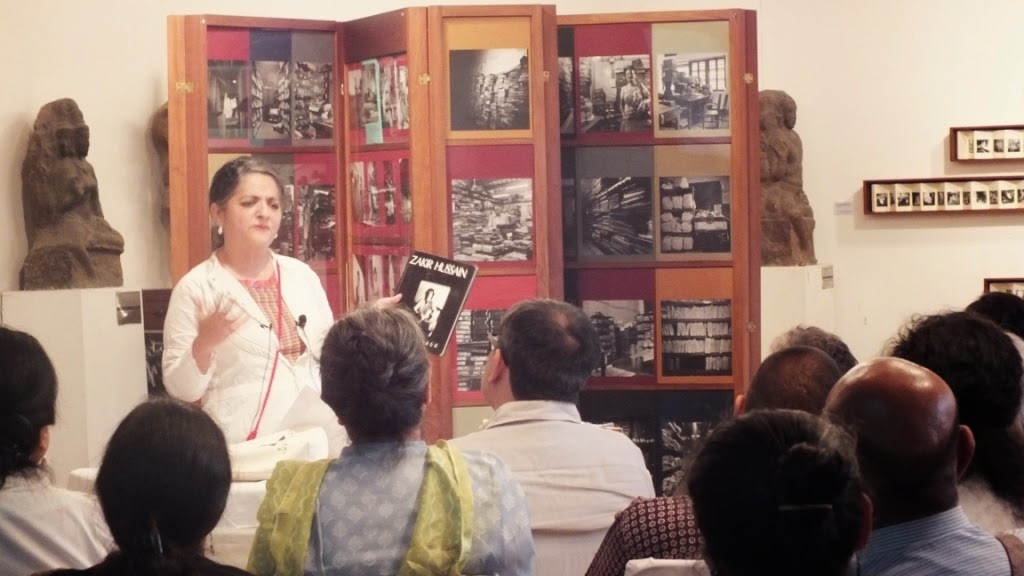
| Professor Parul Pandya Dhar delivers the 9th National Museum Lecture (2) |
सोमवार, 15 सितंबर 2014
9th National Museum Lecture by Dr. Parul Pandya Dhar
रविवार, 14 सितंबर 2014
100 Days Away, Biennale 2014 Braces Up For Bigger Success
Kochi is
gearing up to host the second edition of Kochi-Muziris Biennale, as
the organisers of the 108-day mega art event starting on December 12 are busy
with the preparations for the much-acclaimed mega art festival that is slated
to conclude on March 29, 2015.
Jitish Kallat, the curator and artistic director
for the biennale being organised by the Kochi Biennale Foundation (KBF), said
the second edition would feature around 85 artists from over 28 countries.
Some of
the key artists have already made site visits, and they include Franceso
Clemente, Sir Anish Kapoor, Christian Waldvogel, K G Subramanyan, Sudhir
Patwardhan, Ghulammohammed Sheikh and Namboodiri, among others.
Kallat
said it was a “rewarding moment” for him when conversations with
artist-colleagues, concretize into projects on the ground in Kochi. “The
embryonic form of the project is taking shape,” he noted. “The exhibition
brings together art-works that picture versions of the world referencing
history, geography, astronomy, time and myth, interlacing the terrestrial with
the celestial.”
The full
list of artists will be announced at an exclusive event in a few weeks.
Kallat had been engaged in a year-long research
trip to select the artists for the
much-awaited second edition.
The
organisers are prepping up the venues for the second edition as artists have
already started working on site.
KBF
president Bose Krishnamachari said the foundation has retained most of the
venues from last time. “But we will have a few additional venues and projects
in a few public spaces. And we are looking forward to an engaging project put
up by Kallat,” he added.
KBF has been organising several talks and
cultural programmes as a run-up to the Biennale. Riyas Komu, Director of
Programmes, said the KBF has always been mindful of the larger participation of
the people to engage them with contemporary art.
“To
amplify it this time, we will be having several Programmes including the
Student’s Biennale, Children’s Biennale, Artists’ Cinema project and various
Cultural Programmes that will run parallel to the Biennale,” he added.
The
first edition held in 2012 was an unprecedented national and international success. As expectations run high this time, most of
the hotels, home-stays and boarding and lodging houses in Fort Kochi and nearby
areas have been completely pre-booked.
सोमवार, 28 अप्रैल 2014
Portrayal of Indian womanhood in various hues
New Delhi,
April 28: Seething with anger at the Kauravas who have tried to disrobe her,
Draupadi unlocks her long wavy tresses with a vow that she will tie it again
only after smearing it with the blood of Dushasan, the main culprit.
The flowing
hair, a two-metre-long work of threads and metal hooks and interspersed with
glistening red beads symbolising blood of her tormentor, lies in a glass case
at an ongoing exhibition at the National Museum.
Barely some
distance away, a curvaceous celestial beauty (10th century sandstone Apsara
from Khajuraho) stands under a tree, scribbling a note of love on parchment.
There are nail-marks on her back – a sort of inscription of her lover’s
passionate lovemaking the night before.
These are
among the stirring images of Indian womanhood that filter into your mindscape
as you make a round of “The Body in Indian Art”, a mammoth eight-gallery exhibition
that depicts the single theme of the body with multiple expressions of art.
Significantly,
these images tend to break the stereotypes of Indian womanhood, which has
mostly oscillated between the two extremes of divinity (Sita, Ahalya) and
sensuous physicality (Khajuraho, Kamasutra). India does celebrate the varied
shade of aesthetics of femininity, but this exhibition is an incredible
depiction of womanhood in its scale and depth.
Curated by Dr
Naman Ahuja, Associate Professor of Ancient Indian Art and Architecture at
Jawaharlal Nehru University, the exhibition (titled ‘Roop-Pratiroop’ in Hindi)
goes beyond the clichéd images and patterns to depict the Indian womanhood in
all its shades – ugly and serene, shame and honour, valour and servility – expressed
through images of making love, seeking revenge, committing Sati, and becoming
an ascetic, among others.
The female
figures are not pertinent to the aesthetics of a particular era or faith or
region or culture. Overall, they encompass looks ranging from serene to
violent, from sensuous to divine, thus portraying concepts and emotions as vast
as heroism, asceticism, adoption, fertility, eroticism and rancour, among
others.
The 11-week
(March 14 to June 7) show has been arranged in conformity with the idea of
depicting the thesis along with the antithesis in each of the eight
specially-designed galleries. The trail follows no chronological order; instead
it goes by themes such as death, birth, rebirth, heroism, asceticism and
rapture.
Some of the
exhibits depicting the womanhood are ‘Virasati’
(commemorating a woman warrior from 13th century AD); a textile installation
(of the female genital) by new-age artist Mrinalini Mukherjee; an 18th-century
wooden sculpture of a squatting woman giving birth to a baby; the Mother
Goddesses from Harappa; demoness Putana suckling Krishna; Mallinatha (the Jain
woman ascetic); Saptamatrika or The Seven Mothers (a 2nd or 3rd century AD
terracotta work from Patna Museum); and Surasundaris (a celebration of the body).
“The body is
the bedrock of the studies of art and civilisation in India. The exhibition
seeks to portray the images of women as perceived by different communities and
religions spanning four millennia of Indian civilization,” Dr. Ahuja says about
his magnum opus, which comes to India after enthralling the audiences at
Brussels as part of the famed Europalia art show. The event in the Belgian
capital attracted an audience of over one million people.
There is a
section of the exhibition that looks at the birth of key figures from various
religions, among them Krishna, Buddha, Ram and Jesus. All these figures were
born as a result of an Immaculate Conception or miraculous event – a phenomenon
that makes them divine. Krishna was given up for adoption while Jain leader
Mahavira was transferred – as an embryo – from the womb of his biological
mother to another womb. Significantly, these age-old mythic stories have
compelling resonance in modern times in the concepts of adoption, surrogacy and
in-vitro fertilisation.
Dr Ahuja says
there is no linear way to express femininity. While the apsara sculpture from
Khajuraho celebrates the erotic power of the body, the imperfection is
portrayed in the mid-20th century wooden carving of the demoness Putana, who is
trying to kill the infant Krishna by smearing her breasts with poison.
There is a
statue of a woman warrior from the Kakatiya period (1083-1323 AD) who is
severing her head with a sharp weapon. “It is rare to find examples of women
warriors being commemorated, and it could find a reflection in modern-day women
suicide bombers,” observes the curator. “Women were also commemorated for their
valour and fidelity. This was more commonly done for those who committed sati,
which is reflected in two 13th century sati memorial stones.”
Contemporary
Indian art has also found a place in the exhibition, which weaves the subjects
of birth, death and rapture into the making of a civilisation. Sheela Gowda
brings back to the exhibition her 1997 work “Draupadi’s Vow”; photo artist
N.Pushpamala lends a picture from her collection ‘Native Women’(2000-2004) to
visually analyze women’s submission to cultural codes of India’s colonial
rulers.
“This
exhibition is a watershed,” says National Museum Director General Dr Venu V.
“It is more than double the size of the biggest exhibition we have ever had.
Nearly a quarter of the objects have never been shown before.”
सोमवार, 14 अप्रैल 2014
Comics artists give new hues to National Museum show on body
New Delhi, April 14: If display of historical artworks is meant to trigger novel interpretations,then a landmark exhibition at National Museum here is lending unconventional ideas to the mission.
A comics workshop the museum held as part of ‘The Body in Indian Art’ brought in close to 20 artists, who have begun working on freewheeling thoughts that occurred to them after viewing the 300-plus objects which grace the eleven-week show ending in June.Organised in collaboration with World Comics India, the two-day get-together of young artistes over the weekend saw their sketching imaginary stories coloured on the impression they got on seeing the exhibits that throw light primarily on the depiction of the body over a span of four millennia — across India’s religions, cultures and regions.National Museum Director-General Dr Venu V said the idea behind the workshop was to widen the reach of the March 14-June 7 show to people from various walks and sense their varied feedback. “The exercise would add to the aesthetic dimensions of the exhibition,” he said, referring to ‘The Body in Indian Art’ curated by art historian Naman P Ahuja.The delegates at the workshop that concluded on Sunday evening are slated to submit their artwork in a week. “We plan to come up with a booklet showcasing the comics,” added Dr Venu.World Comics India founder Sharad Sharma, who conducted the workshop, said the exhibition has stimulated the imagination of the artists — they include painters, graphic designers and even a Scandinavian working with her country’s embassy in Delhi.“Almost all of them have come up with exciting themes, often hilarious,” he revealed, while guiding the youngsters on executing their plots. “Quite a few are sarcastic — brimming with social, political and historical undertones.”
Dayanita Singh giving her talk at the Book Museum, National Museum, New Delhi
All the same, not all themes are in lighter vein. For instance, artist Bhanu Pratap said he was working on the mindset of old-time sculptors who invariably left their work unsigned — “something that is unimaginable today.”Norwegian Kathrine Flaak said her focus would be on “the changing manmade image of beauty” over the years.The workshop began on Saturday, hours after National Museum hosted a talk by renowned photographic artist Dayanita Singh, whose show titled ‘Book Museum’ has been on view (from March 10 to May 10) at the second floor.
Participants at the comics workshop captured by the Facilitator, Sharad Sharma
In her hour-long Friday evening talk on ‘Building the Book Museum: photography, language, form’, the author recalled her experiences in the field of capturing images and writing on them.She also explained how the book can be “a museum without walls”, capable of taking its own trajectories by making it to the houses of people across the globe.
सोमवार, 24 मार्च 2014
Rare art objects, never shown before, line up for exhibition at National Museum
New
Delhi, Mar 24: With museums across the country opening their vaults for
a mammoth exhibition currently underway in the national capital, an array of
exquisite art objects, ranging from the
Harappan civilisation to modern times, have become available for public viewing
for the first time.
A few tiny Harappan figures, a
monumental Naga Deva, an 8th-century Uma-Maheshvara, an animal-headed
anthropomorph and a marble tomb of a Mughal lady are among the artefacts being
shown for the first time as part of ‘The Body in Indian Art’ at the National
Museum.
Curated by art historian Naman P. Ahuja, the eight-gallery
exhibition explores the complex understandings of the ‘Body’ in Indian art.
This he does through an entire gamut of cultural artefacts such as sculptures,
paintings, masks, jewellery, amulets, posters, video installations, music clips
and two large textiles.
The 11-week high-voltage exhibition at the museum comes
after a successful showing in Brussels as part of the art festival Europalia
which concluded recently.
“Around 20-25 per cent of the 300-odd artefacts in the
exhibition have never been shown before
and another 60 per cent have seldom been seen before as they were lying in
museums in small towns and were too fragile to be sent to Brussels,” pointed
out Dr Ahuja, an Associate Professor at Jawaharlal Nehru University, Delhi.
The curator, who has spent years
exploring the storerooms (reserve collections) of numerous small
regional museums, said he and his curatorial team located many objects
that were not on public display. Some were even in the gardens of museums
and had thus escaped any critical attention from scholars.
A significant new discovery is the
boar-headed copper anthropomorph (2nd or 1st millennium BC) which was
lying unnoticed in a museum storeroom. Exhibited in Brussels for the first
time, it has now been properly catalogued and is on display here.
“It is a rare piece of art that existed between the
Harappan civilisation and the Mauryan Empire, and takes the story of Indian
gods and goddesses to an earlier date than what we had imagined… It is a huge
find and an exciting object for art historians, archaeologists and linguists.”
Equally fascinating are some tiny Harrapan figures that
are on display here for the first time since they were excavated in 1933. They
comprise a steatite Seal (2500-1700 BC from Kalibangan, Rajasthan); a
terracotta female figurine with animal horns (2500-1700 BC, Mohenjodaro); and
two horned maskes (both almost identical). All these objects have been lying in
the cells of ASI at Purana Quila, Delhi.
Similarly, a monumental Naga Deva — a 9th century
sculpture — has been lent by the Bhopal Museum, and it has never been
shown in a public exhibition before. This remarkable statue is carved from a
porous stone that flakes in a manner that gives it the appearance of
snakeskin.
National Museum Director-General
Dr Venu V said the exhibition is the most extensive collaboration
of museums and collectors across the country. “Significantly, it has
brought into public domain a number of art objects that have remained largely
hidden for the outside world.”
The exhibition in Delhi also features
some objects which did not go to Brussels. An 8th century Uma-Maheshvara, which
has been on display in the Bhopal Museum but never in a public exhibition
before, is one such instance.
Another object being shown for the
first time in India is a marble tomb of a Mughal lady (Delhi region, 17th
century). Kept in the ASI’s Red Fort Archaeological Museum, it is a wonderful
example of Islamic art. Judging by its lavish, white marble and fine
calligraphy, it must have belonged to a member of the imperial family.
A tiny toe-suckling ‘Bal Krishna’ in bronze was found
in the storeroom of Chennai Museum. It did go to Brussels but is being
exhibited in India for the first time.
Particularly special is the book Akitoosha-i-ukba
(Provision for the next world). Made of copper pages with silver
calligraphy, there are the 99 names of Allah inscribed in this extremely rare
book. Being shown for the first time, this is from the ASI’s Museum, Red Fort.
It was made during the reign of Aurangzeb.
The National Museum, the biggest
lender of objects to the exhibition, has also opened its magnificent reserve
collections for first-time viewing. This includes a page of the Shahnama
(written by Persian poet Firdausi between 977 and 1010 AD), depicting the birth
of Rustom, the legendary Persian warrior.
It has also lent a Mughal painting of the Birth of Mary,
based on an engraving by Dutch painter Cornelius Cort (around 1735). Made in
the court of Mohammed Shah, it depicts the bathing of new born Mary, mother of
Jesus, by a group of female attendants.
The Odisha State Museum, Bhubaneswar
has lent eight sculptures, collectively known as Ashta Dikpala (Gods of Eight
Directions). At Brussels, only five of these sculptures, dating from the 12th
century, were shown. But in the Delhi exhibition, all the eight are on display.
गुरुवार, 20 मार्च 2014
पटना में लोक कलाकारों की वृहद कला कार्यशाला 21 से
पटना, 20 मार्च 2014, कला संस्कृति एवं युवा विभाग, बिहार सरकार एवं बिहार ललित कला अकादमी, पटना संयुक्त रूप से दिनांक 21 मार्च से 25 मार्च तक पटना के बहुद्देशीय सांस्कृतिक परिसर में लोक कलाकारों की वृहद कला कार्यशाला का आयोजन करने जा रही है। पाँच दिनों की इस कार्यशाला में राज्य भर से विभिन्न विधाओं के लोक कलाकार हिस्सा लेंगे। मिथिला कला, मञ्जूषा कला, टिकुली कला, सिक्की कला, टेराकोटा, पेपरमेसी एवं भोजपुरी लोक कला के क्षेत्र से 100 कलाकारों का चयन इस कार्यशाला के लिए किया गया है।
इस कार्यशाला का उद्घाटन 21 मार्च को कला संस्कृति एवं युवा विभाग, बिहार सरकार के सचिव श्री चंचल कुमार करेंगे। कार्यक्रम की अध्यक्षता बिहार ललित कला अकादमी के अध्यक्ष एवं वरिष्ठ चित्रकार श्री आनंदी प्रसाद बादल करेंगे।
Museum exhibitions lend contemporary context to artefacts: Expert
New Delhi, March 20: The age-old
inclusiveness of Indian culture is second to none globally and a landmark
exhibition currently on in the country’s capital mirrors its range and depth,
according to renowned art historian Neil MacGregor, who is director of the
British Museum.
‘The Body in Indian Art’, which
opened in National Museum last week showcasing a broad spectrum of aesthetics
in the representation of the human body, exemplifies the harmonious coexistence
of religions in the subcontinent over the past four millennia, the London-based
expert noted in a lecture here.
“Ideally, museums have to be a
secular space. The exhibition reveals its grand extent,” he said in his talk on
‘What can Exhibitions do for Museums’ which was the third in a monthly series
that brings together experts and practitioners from the field of world art and
culture for Indian audiences.
| Dr Neil MacGregor, Director, British Museum, speaking at the Third National Museum Lecture at the National Museum, Delhi |
Dr MacGregor said it “is indeed
remarkable” that the National Museum has pulled together artefacts from over 40
institutions in the eleven-week show here, considering a general reluctance
among museums to lend their objects for exhibitions. “This, when there is a
surge in public appetite to view and experience cultures from across the
world,” added the speaker, who has been heading the British Museum in London
for 12 years after having been director of the National Gallery in the same
city.
On its part, the British Museum that
gets over 6 million visitors a year has been sending its artefacts for
exhibitions round the globe in a big way for the past two decades, earning not
just admirers from across regions and cultures but also triggering
fascinatingly different interpretations to the historical pieces. Redefining old
objects is a major benefit of such an exercise, which can also help museums
gross additional money through increased footfalls, he added.
| Dr Neil MacGregor, Director, British Museum, speaking at the Third National Museum Lecture at the National Museum, Delhi (2) |
The lecture on Tuesday came amid the
March 14-June 7 show curated by Dr Naman P Ahuja of Jawaharlal Nehru University
here in association with the Indian Council for Cultural Relations.
“Objects mean different things to
different peoples,” Dr MacGregor said, recalling the variedly fascinating
response the esoteric Cyrus Cylinder got when British Museum showed the 6th
century BC artefact in four American cities in 2010.
While it was seen more as an art
object in the US, the Cyrus Cylinder was revered when it was displayed in
Tehran on a loan to the museum in Iran. Recently, it was exhibited in Mumbai as
well.
Similarly, an armchair throne made of
decommissioned (Western) weapons — a representation of the end of a bloody
civil war in Mozambique in the late 1970s — underwent a change of profile when
it was shown to a different audience. While the object gained its shape following
a peace-loving priest’s call to barter guns for gifts, its 2012 display in the
British Museum lent the exhibit a completely different perception: it is all
European ammunitions that are used in African battles.
International exhibitions can also conjure
up contemporary art inspired by ancient works, pointed out the 67-year-old
author who has played a vital role in British Museum’s recent leap from being
traditional to contemporary and popular. For example, an exhibition of a Roman
copy of the famed Greek ‘discus thrower’ sculpture of the 5th century BC
prompted a Chinese artist to mould a clothed version of it recently, he pointed
out, screening the contrasting image of middle-aged Sui Jianguo’s ‘Drapery
Folds’ work at Beijing Museum in 2012.
“When you lend an object, everyone
interprets it in his own way, in his own tradition…. We want museums to speak
to everybody, especially those who are not concerned about high cultural
objects…. Museums are the place where dialogues and discourses can take place
which is not possible in any other public place,” he contended.
Expounding on the theme, the art
historian said an exhibition in the British Museum on the Haj turned out to be
a crowd-puller, attracting a mixed and eclectic gathering and 40 per cent of
them were first-time visitors.
“Citizens across the globe feel they
share the inheritance, and museums have a central role to play in creating a
fusion through democratic discourses and dialogues,” he asserted.
Dr MacGregor is in India on the
occasion of the Third Leadership Training Programme for Museum Professionals
which is organised by the Union Ministry of Culture in collaboration with
British Museum. The annual project will train 20 young museum professionals in
museum management and leadership.
The participants at the training
range from museums at the national level (like Bhopal and Hyderabad) to small
private museums, say, in Kargil.
सोमवार, 3 मार्च 2014
Museums on Muziris heritage opened to public
KOCHI (North Paravur, Mar 3): People of Kerala will hereafter get a chance to learn the rich bygone
era of a “lost city” which played a crucial role in moulding the socio-politico
culture of the state, with the government on Sunday opening four museums under
the Muziris Heritage Project.
The museums available for visitors are the Kerala History Museum,
housed in the Paliam Kovilakam, Kerala Lifestyle Museum in Paliam Nalukettu,
Kerala Jews Historical Museum housed in Paravur Synagogue and Kerala Jews
Lifestyle Museum in Chendamangalam Synagogue. All museums are equipped with
video screens, touch screens and information panels to help the visitors
understand the rich history of the region.
| Paliam Trust manager Krishnabalan Paliath explaining the details of the antiques displayed at Kerala History Museum, opened for public on Sunday, to Toursim director S Harikishore. |
Kerala Tourism Director Shri S Harikishore, who visited and opened the
museums for public on Sunday, said that the mega heritage project would be
inaugurated after the completion of visitors centre, activity centre,
convention and research centre and hop on-hop off boat service. “We decided to
open the museums for public because we completed the conservation projects on
time and deployed staff and guides in the museums. In addition to the four
museums, the people can also visit heritage sites like Pattanam, Paravur
Market, Kottappuram Fort, Kottapuram Market, Cheraman Juma Masjid, Gothuruthu
Performance Centre and Pallipuram Fort,” he said.
Shri Harikishore said that the museums would remain open from 10 am to
5 pm on all days except Monday.
“The Muziris Heritage Project is one of the biggest conservation
projects in the modern history of India. It is because of this magnitude that
both the Central and state governments have come together to conserve and
showcase a culture of more than three millennia,” Hon’ble Minister for Tourism
Shri A P Anil Kumar said.
He said “the project gives the people an opportunity to walk the same
road once travelled by explorers and traders in ancient Muziris.”
Paliam Kovilakam was the residence of Paliath Achans, who were prime
ministers to the erstwhile maharajas of Kochi in the 16th century. An
architectural wonder, with its carved stairways and balustrades, the Paliam
Kovilakam is situated in Chendamangalam. The 18th century Paliam Nalukettu was where
the female members and minor boys of the Paliam family lived.
![]() |
| Paliam Trust manager Krishnabalan Paliath explaining the details of the antiques displayed at Kerala History Museum, opened for public on Sunday at North Paravur, to Toursim director S Harikishore. |
The project site is spread across North Paravur municipality in
Ernakulam district and Kodungallur municipality in Thrissur district with 12
panchayats--Chendamangalam, Chittatukara, Vadakkekara, Pallipuram, Eriyad, Mala,
Mathilakam, Poyya, Puthenvelikkara, Sree Narayana Puram, Vellangalore and Edavilangu.
“The Muziris Heritage Project
focuses on sustainability and involvement of local communities. The project
follows international guidelines such as the UNESCO Charters on heritage
conservation,” said Kerala Tourism Secretary Shri Suman Billa.
![]() |
| Paliam Trust manager Krishnabalan Paliath explaining the details of the antiques displayed at Kerala History Museum, opened for public on Sunday at North Paravur, to Toursim director S Harikishore. |
The museums will provide the people an insight into multi-layered
history of the ancient port city, which mysteriously disappeared sometime after
the 1st century A.D.
The state government’s decision to revive the Muziris Heritage Project
has been widely praised by countries across the world, including China, South
Korea, Japan, Singapore, Russia and Bangladesh. The UNESCO and the United
Nations World Tourism Organization (UNWTO) have also backed the state
government’s conservation efforts.
गुरुवार, 27 फ़रवरी 2014
वरिष्ठ कलाकारों की प्रदर्शनी की श्रृंखला में एक और कड़ी
पिछले कुछ वर्षों से बिहार सरकार ने चाक्षुस कला के क्षेत्र में कई नए अध्याय जोड़े हैं जिसमे बिहार के वरिष्ठ कलाकारों की एकल एवं सामूहिक प्रदर्शनी शामिल है। इस प्रदर्शनी श्रृंखला की अगली कड़ी के रूप में अति वरिष्ठ कलाकार श्री सत्यनारायण लाल के चित्रों की एकल प्रदर्शनी एवं वरिष्ठ कलाकारों की सामूहिक कला प्रदर्शनी का संयुक्त रूप से प्रदर्शन 1 से 6 मार्च 2014 तक किया जाएगा। कला, संस्कृति एवं युवा विभाग बिहार सरकार द्वारा आयोजित सामूहिक प्रदर्शनी के तहत श्रीमती रेखा कुमारी, अर्चना कुमार, श्री अंजनी कुमार, श्री वीरेंद्र नाथ बरियार, सुल्तान मुज़फ्फर आज़ाद, निरंजन कुमार, मंजरी चक्रवर्ती एवं जीतेन्द्र मोहन के चित्रों को सामूहिक रूप से प्रदर्शित किया जाएगा। प्रदर्शनी का आयोजन बिहार ललित कला अकादमी की कला दीर्घा में होगा। इस आयोजन का उद्घाटन कला संस्कृति एवं युवा विभाग के सचिव श्री चंचल कुमार करेंगे।
सोमवार, 3 फ़रवरी 2014
नरेश की प्रदर्शनी मुम्बई में
3 फ़रवरी 2014
![]() |
| नरेश अपनी कृति के साथ |
मनुष्य स्वभाव से हीं घुम्मकड़ प्रवृत्ति का रहा है, कभी आजीविका के लिए तो कभी उत्सुकता वश। आज हमारे पास आवागमन के कई आधुनिक साधन है पर एक वो भी समय था जब थोड़ी सी दूरी तय करने में महीनो लग जाते थे। तब भी मनुष्य अपने घुम्मकड़ स्वभाव को बड़े उत्साह के साथ अंजाम देता था।
आज के परिपेक्ष में अगर हम देखें तो लोगों में अपने घर को छोड़, अपनों से दूर जाने कि विवशता काफी बढ़ी है। बिहार एक ऐसा राज्य रहा है जहाँ के लोगों का दूसरे राज्यों या विदेशों में जीविकोपार्जन के लिए पलायन बहुतायत हुआ है। आम तौर पर यही लगता है कि लोग मौज-मस्ती के लिए बाहर का रुख करते हैं पर क्या असलियत में ऐसा है ? क्या अपने घर में अपनों के साथ बैठ कर टेलीविजन पर सिनेमा देखने से ज्यादा आनंद अपनों से दूर बेतहाशा ठंढ तथा चमड़ी जला देने वाली गर्मी में घर से बहार निकल कर मजदूरी करने में आता है ? ऐसे सवालों का सही जवाब वही दे सकता है जो इसे करीब से देखा हो या जिया हो।
नरेश कुमार एक ऐसे युवा कलाकार है जिन्होंने अपने शहर से दूर दिल्ली में रह कर इसे बखूबी जाना है। इन्होने इसी विषय को अपनी कला सृजन का आधार बनाया है। इन दिनों नरेश की इसी विषय पर आधारित आकर्षक कृतियों की एकल प्रदर्शनी मुम्बई में चल रही है। 11 जनवरी से शुरू हुई इस प्रदर्शनी का समापन 5 फ़रवरी को होगा।
![]() |
| शीर्षक- आनंदी देवी |
![]() |
| शीर्षक- कोलम्बस |
![]() |
| शीर्षक- past present and future |
![]() |
| portit of the home town III |
![]() |
| portrait of home town |
![]() |
| The Capital |
National Mission on Libraries a Stride to Empowerment: President
New
Delhi, Feb 3:
India is poised to gain its pace of
socio-cultural and economic development with the launch of the ambitious National
Mission on Libraries (NML) today, President Shri Pranab Mukherjee said.
Hoping that the NML — a lofty initiative of the
Ministry of Culture to modernise and digitally link public libraries across the
country — would ensure upgradation of libraries providing services to the
public, he said effective knowledge creation and deployment could lead to
societal transformation and wealth generation.
“I am sure the NML will promote enlightenment and
understanding and go a long way in making the masses active participants in the
affairs of the nation,” he said at the function convened at Rashtrapati Bhavan
to launch the NML which entails an expenditure of Rs 400 crore during the 12th
Plan period (2012-17).
Shri Mukherjee also inaugurated the NML’s
guidelines, logo and website in the presence of Culture Minister Smt. Chandresh
Kumari Katoch and senior officials of the ministry.
The President particularly stressed the importance
of the proposed creation of a National Virtual Library of India (NVLI) in the
national capital, noting that it would provide equitable and universal access
to knowledge resources.
The NVLI would provide digital resources “by
digitizing reading material in different languages, which would be shared at
all levels”, he noted.
Its target users would not only be students,
researchers, doctors and professionals but also the educationally, socially,
economically and physically disadvantaged groups. “Thus, it would empower
people with information in order to create a knowledge society and ensure
preservation of digital content for posterity,” ShrI Mukherjee said.
The NML would work towards launching model
libraries — thus setting a benchmark. “These model libraries would be
facilitated with subscription of e-journals and e-book services through Web VPN
services developed by National Informatics Centre. These would be also be
provided with reading resources to meet the local needs,” he pointed out.
The President hailed the NML for its plans to
conduct a holistic professional and personal development programme for library
professionals through capacity building. For, capacity building “is a necessary
investment in people, organizations and services to enhance operating
efficiency, expertise and skills of personnel towards the achievement of
organizational excellence, he noted.
In her presidential address, Minister Smt Katoch
noted that automation of libraries had become imperative to meet the demands of
the digital era.
She noted that the NML was set up in pursuance of
a report of the National Knowledge Commission which strongly recommended
revamping the Library and Information Service sector. The Union Cabinet gave it
the stamp of approval at a meeting, presided over by Hon’ble Prime Minister Dr
Manmohan Singh, on November 28 last year.
Shri Deepak Paintal, Chairman of the High-Level
Committee on the NML, outlined the policy objectives and the roadmap to their
implementation.
Shri Ravindra Singh, Secretary to the Union
Ministry of Culture, welcomed the gathering, while Shri V Srinivas, Joint
Secretary, proposed thanks.
The NML would strive to develop six libraries
under the Culture Ministry, 35 Central Libraries in states and as many District
Libraries as model libraries. Emphasis will on developing these libraries in
economically backward districts. Further, 628 district libraries across the
states would be provided network connectivity. For setting up of the model
libraries, existing libraries would be identified in consultation with the
state governments to improve infrastructure and upgrade technology used by
them.
The revamped libraries would catalogue not just books
and journals but also all policies of the government in public domain to
facilitate easy access and research work.
Besides upgrading the infrastructure of public
libraries, a major component of NML is to initiating need-based training
programmes to develop managerial skills and IT competencies of their personnel
in tune with demands of the Internet era.
Kolkata-based Raja Rammohun Roy Library Foundation
is the nodal agency for the implementation of NML, which is a 10-member body
headed by Prof. Pental, a former Vice Chancellor of Delhi University.
सदस्यता लें
संदेश (Atom)


+-+2+Apr+2014+-+Page+%2324.jpg)